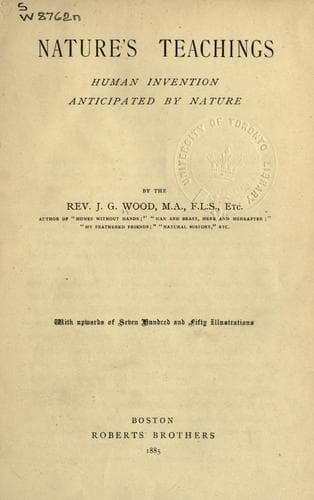
Nature's Teachings: Human Invention Anticipated by NatureWood, J. G. (John George)
History
Nature's Teachings: Human Invention Anticipated by Nature
Wood, J. G. (John George)
Inventions; Natural history
The savage, as a matter of necessity, makes a fire in the middle of his
hut, and lets the smoke have its own way. Sometimes, as is the case with
the North American Indians, the top of the conical hut is open, and the
whole edifice is a single chimney of large dimensions, something like
the “chimney-corner” of past days, which only survives in such places as
the New Forest.
Then there are the various Kafir tribes of Southern Africa. They have no
aperture in their huts except the tiny doorway, which can only be
entered on hands and knees. But they must have their fire. No argument
can persuade them that they had better make their fire and cook their
food outside the hut. So the wood-smoke fills the hut, coats it with a
lining of soot, and gets out as it can through the sticks and withes of
which the simple edifice is built.
As a contrast, we have the oil-lamp of Esquimaux-land, where there is no
provision for ventilation, where the snow-houses are tightly closed and
crammed with inhabitants, and where no one seems to need fresh air.
The next step in civilisation is to construct a tube for the purpose of
carrying off the smoke, such as we know by the name of chimney or flue,
and to place the fire within it. We English people have an ingrained
love for the open fireplace, and though it really is an expensive
arrangement, it is worth the cost. Granting that it carries much of the
heat into the chimney instead of throwing it into the room, it has at
least the advantage of acting as a ventilator, of ejecting air which has
been rendered poisonous by respiration, and drawing a fresh supply from
the outer atmosphere.
In some parts of the world, especially in Germany and the United States,
the place of the open fire is taken by closed stoves, without any
ventilation whatever, much to the discomfiture of ordinary Englishmen.
Still, there are buildings, such as public halls and places of worship,
in which open fireplaces are wholly impracticable, and where it is,
therefore, necessary to make use of the stove.
It need hardly be said that in such cases the chief object is to procure
the greatest amount of heat with the least expenditure of fuel, and that
object seems to be best attained by the Laminated Stove shown on the
right hand of the illustration.
[Illustration: GILLS OF SHARK.]
[Illustration: GILLS OF TROUT.]
[Illustration: STOVE.]
In this stove, the outer surface, instead of being plain, is divided
into a number of perpendicular plates, which are heated by the
contained fire, and expose a very large surface of hot metal to the air.
Thus the heat, instead of being wasted by being drawn through the flue
or chimney, is thrown into the room, and keeps up a perpetual supply of
warm air.
* * * * *
THAT the invention of this stove is an ingenious one nobody can deny.
But Nature has been long in advance of Art in the way of exposing as
large a surface as possible with the least expenditure of space.
Public-domain text, read in full here on John Shaqi.
Reviews
Reviews
No reviews yet
Be the first to share your thoughts on this work.
Elsewhere in the archive
Join the Discussion
Join the discussion
Sign in to leave a comment or review.
Sign InorCreate an account