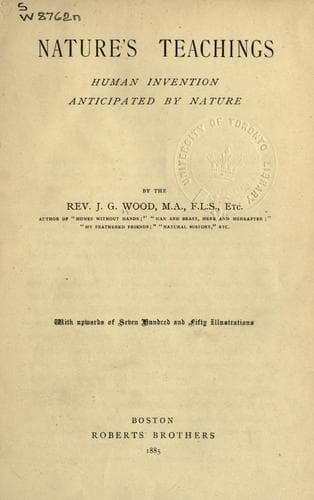
Nature's Teachings: Human Invention Anticipated by NatureWood, J. G. (John George)
History
Nature's Teachings: Human Invention Anticipated by Nature
Wood, J. G. (John George)
Inventions; Natural history
Very familiar examples of this structure may be found in the many
creatures which inhabit the waters and breathe by means of gills, which
extract the oxygen of the water.
Take, for example, a Lobster or a Crab, open it, and look at the white,
pointed, uneatable objects which are popularly called “ladies’ fingers.”
These are the gills, or breathing apparatus, and their structure is
really wonderful. They are composed of innumerable laminæ, or very thin
plates, covered with an exceedingly fine membrane, and placed closely
side by side, but with sufficient distance between them to allow the
water to percolate the whole structure.
With the aid of an ordinary pocket lens the observer may make out a most
wonderful system of blood-vessels, which permeate every one of the
myriad laminæ, and which extract the life-giving oxygen from the water
as it passes between them.
Then, to pass to animals of a higher order, take the gills of fishes.
Any fish will do, provided that it be fresh, and, if it can be examined
immediately after death, so much the better. Taking things reciprocally,
the gills of the fish and the laminæ of the stove, are identical in
principle, namely, the exposure of much surface with little loss of
space.
If possible, the observer should inject the blood-vessels of the gills
with the conventional crimson and blue wax, showing the currents of the
arterial and venous blood. Each lamina forms a most wondrous object, and
may be gazed upon for weeks with increasing admiration.
Every one who has watched the habits of fishes must have noticed that in
running waters they always have their heads against the stream, and do
not greatly care about shifting their positions.
In still waters, especially such as those of the ordinary glass
aquaria, the fish are perpetually on the move, whereas in such a river
as the Dove of Derbyshire, and even the Darenth of Kent, large trout may
be seen almost motionless, but invariably with their heads directed up
the stream.
The reason is evident enough. As long as the fish lies with its head up
the stream the water flows through its gills, and enables it to breathe.
Were the passage of the water stopped, the fish would be drowned.
Consequently, all good anglers, when they hook a fish which is worth
taking, keep its head down the stream, prevent the water from washing
over its gills, and consequently render it so weak by deprivation of
oxygen, that it becomes an easy prey, and is rendered subservient to a
line of a single hair. Let the fish breathe, and a single struggle would
smash a line of treble the strength. But keep it from breathing by
directing its head down the stream, and it rapidly loses all strength,
and can be directed into the landing-net, or brought within the scope of
the gaff, without a chance of escape.
* * * * *
Public-domain text, read in full here on John Shaqi.
Reviews
Reviews
No reviews yet
Be the first to share your thoughts on this work.
Elsewhere in the archive
Join the Discussion
Join the discussion
Sign in to leave a comment or review.
Sign InorCreate an account