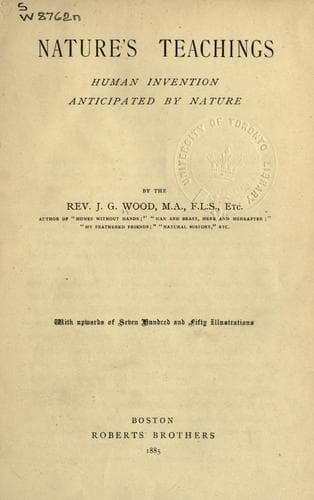
Nature's Teachings: Human Invention Anticipated by NatureWood, J. G. (John George)
History
Nature's Teachings: Human Invention Anticipated by Nature
Wood, J. G. (John George)
Inventions; Natural history
One of his comrades ascended to the roof of a lofty building, hung by
his legs to one of the rafters, and held in his hands a bamboo pole
which was twenty feet long. Another Japanese also ascended, climbed over
his comrade, and settled on the bamboo pole, to which he clung only by
the clasp of his bare feet. Suddenly he slipped down the pole, stopped
himself when within a few inches of the end, squatted there with perfect
unconcern, though at least forty feet from the ground, took his fan from
the back of his neck, and fanned himself while gravely surveying the
startled audience.
[Illustration: PALM-LEAF.]
[Illustration: JAPANESE HAND-SCREEN.]
Perhaps some of my readers may remember Chang, the Chinese giant, who,
by the way, in private life was a polished gentleman. He was never
without his fan, always keeping it fluttering gently with an ease only
to be acquired by a lifelong practice, and I really think that if he had
been deprived of it he would have been seriously ill. How he slept
without it is a wonder, for in his own house the fan was incessantly in
motion, and was worked with apparent unconsciousness on his part.
I have often wished that in our country the ladies would manage their
fans in the same quiet way when they are in a church or a concert-room,
for the perpetual rattle of the joints is enough to distract any
preacher or conductor, and very often does so.
As to the shape of the Fan, it varies greatly according to the country,
but it may almost invariably be traced to some familiar object.
There is, for example, the common Japanese Fan or Screen, which is
avowedly made on the model of the Palm-leaf, the ribs of the leaf being
represented by split portions of a bamboo stem. The right-hand figure in
the preceding illustration is taken from one of the common sixpenny
Japanese fans that may be seen in many shop-windows.
There are exactly sixty ribs in the fan, all produced by splitting the
bamboo into strips, kept in their place by a slight rod of the same
material, and covered with two pieces of thin printed paper. Seeing that
the original cost cannot be more than a penny, it is wonderful how such
articles can be produced, and give a living to the makers.
The reader will observe that the shape of the Japanese Fan is almost
exactly that of the Palm-leaf, with the exception of the jagged edges,
and a better pattern could not be found. Then there are many Indian Fans
framed on the same model, but which revolve on their handles, and are
swung slowly round and round by the servants before the guests, and thus
become miniature punkahs.
Public-domain text, read in full here on John Shaqi.
Reviews
Reviews
No reviews yet
Be the first to share your thoughts on this work.
Elsewhere in the archive
Join the Discussion
Join the discussion
Sign in to leave a comment or review.
Sign InorCreate an account