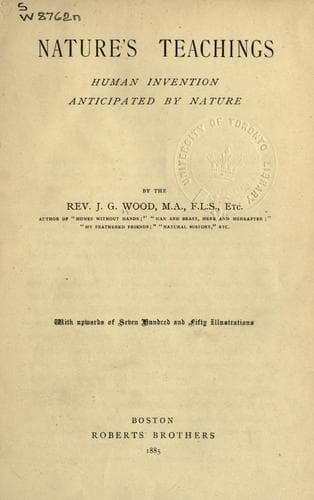
Nature's Teachings: Human Invention Anticipated by NatureWood, J. G. (John George)
History
Nature's Teachings: Human Invention Anticipated by Nature
Wood, J. G. (John George)
Inventions; Natural history
Here, again, we may find a parallel in Nature. The common hive bee
ventilates its dwelling by using its wings in lieu of fans. When the
hive is really in want of fresh air, the bees set to work, and wave
their wings backwards and forwards for a considerable time, so that they
necessarily expel the foul air from the interior of the hive, and create
a partial vacuum, which can only be filled by fresh air from without.
Fans of very similar shape are in use among the South Sea Islanders and
the inhabitants of the Essequibo district. They are often used as
bellows when a fire has to be raised, but their primary object is to be
employed as fans.
* * * * *
NEXT we come to those fans which are made of flattened sticks, which
move on a pivot. This is, indeed, the ordinary form of the fan at the
present day, the sticks being sometimes wide enough to constitute the
entire fan, but mostly being connected with a sort of lining made with
silk, paper, or feathers. Such fans as these can be moved on their
pivots, so as to occupy a comparatively small space; and the same can
be said of the modern fender-guards, which can be folded up when the
room is unoccupied, and which form an effectual protection against the
danger of ladies’ dresses coming in contact with the fire.
Examples of such a screen, and two fans, are given on the right hand of
the accompanying illustration.
[Illustration: ANTENNA OF COCKCHAFER.]
[Illustration:
IVORY FAN. FEATHER FAN.
FIRE-GUARD.]
On the left hand is shown one of the natural objects from which the
fans, &c., might well have derived their origin. It is one of the
antennæ--or horns, as they are popularly called--of the common
Cockchafer. The end of this antenna is composed of a number of flat
plates, which work on a pivot exactly like the sticks of a fan, and,
like those sticks, can be folded into a wonderfully small compass, or
opened out into a fan-like shape.
BURIAL.
Last scene of all.
I do not think that it matters very much to one who has “shuffled off
this mortal coil” what becomes of the coil in which he had been
imprisoned. Whether the abandoned body be buried in the earth, or sunk
in the sea, or devoured by wild beasts, or consumed by fire, signifies
nothing to him, though it may signify much to his surviving friends.
As a rule, the animals, of whatever kind they may be, contrive to
dispose of their mortal remains in some mysterious manner, so that not
a vestige of them is to be found. Take, for example, the domestic cat,
and see how few bodies are found of cats which have died natural deaths.
Public-domain text, read in full here on John Shaqi.
Reviews
Reviews
No reviews yet
Be the first to share your thoughts on this work.
Elsewhere in the archive
Join the Discussion
Join the discussion
Sign in to leave a comment or review.
Sign InorCreate an account