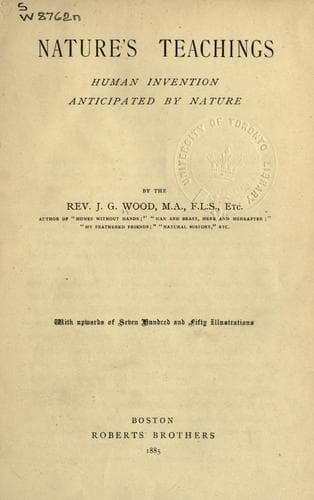
Nature's Teachings: Human Invention Anticipated by NatureWood, J. G. (John George)
History
Nature's Teachings: Human Invention Anticipated by Nature
Wood, J. G. (John George)
Inventions; Natural history
For instance, there was my own cat “Pret,” who lost his life from the
bites of rats. He was blind, and so lamed that he could scarcely crawl.
Yet, on the day of his death, he three times escaped from his
comfortable bed in front of the fire, dragged himself through a hedge,
down a steep bank, across a road, up another bank, through a crevice in
a park fence, and curled himself up to die under a blackberry-bush.
[Illustration: BURYING-ANTS.]
[Illustration: SAVAGE FUNERAL.]
Perhaps it was mistaken kindness on my part, and I should have acted
better if I had left him to die in peace. But, though I carried him back
three times, and though he was quite unable to see, he contrived to slip
out of the house, and to find the same spot for his last resting-place
on this earth.
I have heard that some cats have been known to bury their young, and Dr.
J. Brown tells a most touching story of a dog that committed her dead
puppy to the river.
But as to Insects, until a few years ago, no one ever dreamed that the
principle of burial could be found among them. What millions of insects
die in every year, and how seldom is a dead insect found! Flies, gnats,
and the smaller insects might escape observation, but the large moths,
butterflies, beetles, dragon-flies, &c., are scarcely ever found dead.
In my own neighbourhood, for example, the Stag-beetle, nearly the
largest and most conspicuous of British insects, swarms to an almost
unpleasant degree, especially in the summer evenings.
Yet I have never found a dead Stag-beetle that had not been killed by
violence. What becomes of the bodies of the countless millions of
creatures that annually pass into their other world is a problem which
at present no one seems to be able to solve.
* * * * *
STILL, there are instances where even insects are known to bury their
dead, and I scarcely need say that they are to be found among the Ants.
The story is a very curious one, and is narrated at length in the
_Journal of the Linnæan Society_, vol. v. p. 217.
It happened that a lady found that her little boy was being stung by
ants, and she at once killed them and threw their dead bodies away.
After some time a number of ants came out of their nest, formed a
procession as regularly organized as that of any undertaker’s funeral,
dug graves for each dead ant, laid the body in it, and covered it up
again with earth.
They carried their organization to such an extent that they even had
relays of bearers. But the strangest part of the story is that several
worker ants would not assist in the funereal ceremonies. The soldiers at
once set on them, killed them, and tumbled them all promiscuously into a
common grave.
Such scenes were repeatedly witnessed by the lady, a Mrs. Hutton, who
wrote the account while she was living in New South Wales.
USEFUL ARTS.
CHAPTER X.
WATER, AND MEANS OF PROCURING IT.
Public-domain text, read in full here on John Shaqi.
Reviews
Reviews
No reviews yet
Be the first to share your thoughts on this work.
Elsewhere in the archive
Join the Discussion
Join the discussion
Sign in to leave a comment or review.
Sign InorCreate an account