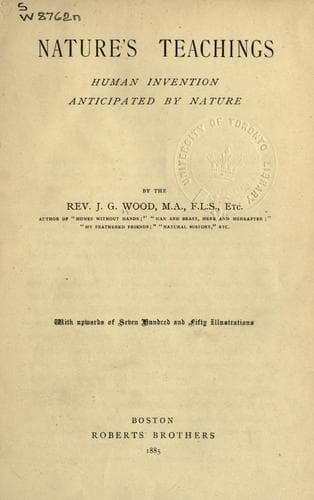
Nature's Teachings: Human Invention Anticipated by NatureWood, J. G. (John George)
History
Nature's Teachings: Human Invention Anticipated by Nature
Wood, J. G. (John George)
Inventions; Natural history
The most perfect and most familiar example is, perhaps, the common
Hedgehog, which, when rolled up, displays an array of sharp points so
judiciously disposed, that it fears but very few foes. The same may be
said of the Australian Echidna, or Porcupine Ant-eater, and the
Porcupine itself. Whether the radiating bristles of the larva of the
Tiger-moth, commonly called the Woolly Bear, come under the same
category, I cannot say, but think it very likely.
Among vegetables the analogues are multitudinous. See, for example, the
spikes of the Spanish and Horse Chestnuts, and especially the hair-like
but formidable bristles which defend the common Prickly Pear. Indeed,
all that tribe of plants is furnished so abundantly with natural
ranjows, that a hedge of prickly pear forms the best defence which a
house and garden can have.
Another example of natural ranjows is seen in the Tree-caddis, one of
which is shown in the illustration on page 108, as it appears when
suspended from a twig. It is the work of one of the House-builder Moths
of the West Indies, and forms a sort of house in which the caterpillar
can rest securely. It is built of bits of twigs and thorns, the latter
being disposed so that their points are outwards, much after the fashion
of a hedgehog’s spines.
I possess many specimens of Tree-caddis, evidently belonging to several
species, and in all of them the principle is the same, _i.e._ a number
of spikes set with their ends outwards in order to defend a central
position.
Sometimes these spikes are left exposed, as shown in the illustration,
and sometimes they are covered with a slight but strong web. The
principle, however, is the same in all.
* * * * *
NOW I shall have to use two very long words, and much against my will. I
very much fear that, if most of my readers were to hear any one speak of
the “repagula of Ascalaphus,” they would not be much the wiser. And yet
there are no other words that can be used.
In the first place, Ascalaphus is a name belonging to a genus of
Ant-lions, remarkable for having straight, knobbed antennæ, very much
like those of a butterfly. This insect deposits its eggs in a double row
on twigs, and then defends them with a series of natural ranjows, set in
circular rows, and supposed to be without analogies in the animal
creation. They are transparent, reddish, and “are expelled by the female
with as much care as though they were real eggs, and are so placed that
nothing can approach the brood; nor can the young ramble abroad until
they have acquired strength to resist the ants and other insect
enemies.”
The word “repagulum,” by the way, signifies a bar or barrier. A
turnpike gate when closed would be a repagulum, and so would a
chevaux-de-frise.
TEARING WEAPONS.
Public-domain text, read in full here on John Shaqi.
Reviews
Reviews
No reviews yet
Be the first to share your thoughts on this work.
Elsewhere in the archive
Join the Discussion
Join the discussion
Sign in to leave a comment or review.
Sign InorCreate an account