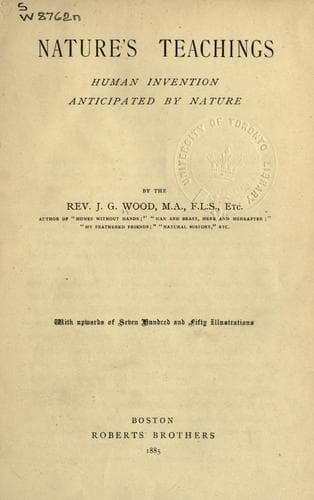
Nature's Teachings: Human Invention Anticipated by NatureWood, J. G. (John George)
History
Nature's Teachings: Human Invention Anticipated by Nature
Wood, J. G. (John George)
Inventions; Natural history
When it has secured its prey, it seeks the bottom of its burrow, makes
its meal in quiet, and reascends. How it does so we shall soon see.
Towards the end of the body, one of the segments is much enlarged, and
has a bold prominence upon the back. On the summit of this prominence
there are two horn-like hooks, shaped as seen in the illustration. These
hooks are used exactly like the boy’s climbing-spurs, the alternate
elongation and contraction of the body answering the same purpose as the
movements of the boy’s legs. When the larva has seized its prey and
wishes to retreat, all that it has to do is to withdraw the hooks,
straighten the body, and down it falls by its own weight.
* * * * *
IN the nautical branch of this subject I have already treated of the
curious pushing-poles by means of which the Serpula protrudes itself
from its tube. As all must have noticed who have seen these creatures
alive, the Serpula protrudes itself very slowly, but flies back into its
tube with such velocity that the eye can scarcely follow its movements.
Its difference of motion shows that there must be a difference in the
means by which these movements are produced.
Referring to the illustration on page 45, the reader will see that the
instruments with which the Serpula propels itself are used just after
the fashion of punt-poles, and cannot act with any great swiftness.
When, however, the creature wishes to withdraw itself, it employs a
curious apparatus, consisting of many rows of little hooks. The points
of these hooks readily catch against the lining of the tube, and by
their aid the worm jerks itself back with wonderful celerity.
Three rows of these hooks are shown next to the Tiger-beetle larva.
The structure of these remarkable organs is elaborately described by Mr.
Gosse in his “Evenings with the Microscope:”--
“If you look again at this Serpula recently extracted, you will find
with a lens a pale yellow line running along the upper surface of each
foot, transversely to the length of the body. This is the border of an
exceedingly delicate membrane, and, on placing it under a high power
(say six hundred diameters), you will be astonished at the elaborate
provision here made for prehension.”
“This yellow line, which cannot be appreciated by the unassisted eye, is
a muscular ribbon, over which stand edgewise a multitude of what I will
call combs, or rather subtriangular plates. These have a wide base, and
the apex of the triangle is curved over into an abrupt hook, and then
this cut into a number (from four to six) of sharp and long teeth.”
“The plates stand side by side, parallel to each other, along the whole
length of the ribbon, and there are muscular fibres seen affixed to the
basal side of each plate, which doubtless give it independent motion.
Public-domain text, read in full here on John Shaqi.
Reviews
Reviews
No reviews yet
Be the first to share your thoughts on this work.
Elsewhere in the archive
Join the Discussion
Join the discussion
Sign in to leave a comment or review.
Sign InorCreate an account