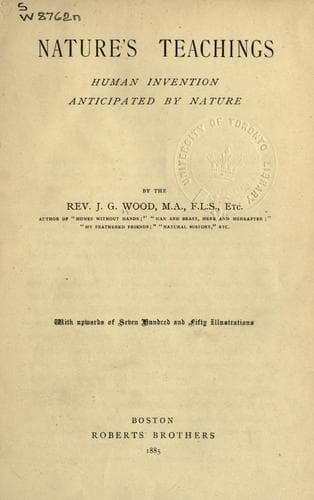
Nature's Teachings: Human Invention Anticipated by NatureWood, J. G. (John George)
History
Nature's Teachings: Human Invention Anticipated by Nature
Wood, J. G. (John George)
Inventions; Natural history
“I have counted one hundred and thirty-six plates on one ribbon. There
are two ribbons on each thoracic segment, and there are seven such
segments. Hence, we may compute the total number of prehensile comb-like
plates on this portion of the body to be about one thousand nine
hundred, each of which is wielded by muscles at the will of the animal;
while, as each plate carries on an average five teeth, there are nearly
_ten thousand teeth_ hooked into the lining membrane of the cell, when
the animal chooses to descend.”
“Even this, however, is far short of the total number, because long
ribbons of hooks of a similar structure, but of smaller dimensions, run
across the abdominal segments, which are more numerous than the
thoracic. No wonder, with so many muscles wielding so many
grappling-hooks, that the descent is so rapidly effected.”
Lastly, we come to the Walrus, whose strangely elongated upper canine
teeth can be used for just the same purposes as the scaling-fork or
climbing-spur. As, however, reference has already been made to these
tusks, in connection with another department of this work, there is no
necessity for occupying space with a second description.
DEFENCE OF FORT.
So much for attack; now for defence.
The simplest mode of defending a fort, or even a mountain pass, is by
throwing or rolling rocks and heavy stones against the enemy.
Simple as it may appear, it is a very effective one, as can be well
understood by those who have rolled a huge stone down a long and steep
slope. The stone goes gently enough at first, but rapidly gains speed,
until at last it makes great bounds from the earth, tearing and crashing
through everything as if it had been shot from a cannon.
I have seen a stone which was too heavy to be lifted, and had to be
prised over the edge with levers, spring completely through the topmost
branches of a high tree, scattering the boughs in all directions, and
then, alighting on another stone, split into many fragments, just like
the pieces of a burst shell. That one stone would have swept off a whole
party of soldiers had they encountered it while trying to ascend the
slope.
This invention has also been anticipated in Nature.
Putting aside the obvious reflection that the most primitive warriors
must have noticed the effects of stones falling over a precipice, we
have, in Captain Hall’s “Life with the Esquimaux,” a curious account of
the Polar Bear and its mode of killing the Walrus. Gigantic as is this
animal, and terrible as are its tusks, the Polar Bear will sometimes
attack it in a very singular manner. The Bear springs on a sleeping
Walrus, and clings to its shoulders with one paw, and with repeated
blows from the other, fractures its skull.
Still, the combat is sure to be a severe one, and so the Polar Bear
will, if he can, secure his prey by some other method.
Public-domain text, read in full here on John Shaqi.
Reviews
Reviews
No reviews yet
Be the first to share your thoughts on this work.
Elsewhere in the archive
Join the Discussion
Join the discussion
Sign in to leave a comment or review.
Sign InorCreate an account