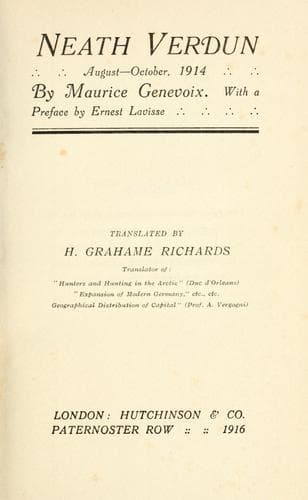
'Neath Verdun, August-October, 1914Genevoix, Maurice
History
'Neath Verdun, August-October, 1914
Genevoix, Maurice
Verdun, Battle of, Verdun, France, 1914
_Midday._ Conveyances are passing along the road at the foot of the
hill: huge four-wheeled wains, each drawn by a thin, mangy horse.
Wickerwork baskets, bales of household goods, rabbit hutches, have
hastily been flung into them. On the top, mattresses, pillows,
eiderdowns of a faded red have been piled. And on these are sitting
women with backs hunched and bent, their clasped hands drooping over
their knees, their eyes dull and blank. One cannot tell from their
expressionless faces whether or not they are suffering. They seem to
be immersed in reflections purely animal and without end. Here and
there from amid this lamentable medley of goods protrude the heads of
dirty-nosed urchins, with light hair tangled and matted. A few
bellowing cows follow the wagon, dragging at the ropes by which they
are tied, and lowing. An awkward youth with large hands and immense
feet, whip in hand, drives them forward by kicking them lustily in the
haunches.
Suddenly, cries and the rattle of triggers ring out. I turn swiftly to
find thirty of our men deploying as skirmishers, facing the crest. Our
old captain, red as a beetroot, his small scared eyes darting wildly
round, shouts at the top of his voice:
"Look out! Look out! Rapid fire! ... upon the enemy approaching ... at
800 yards...."
What can all this mean? Have we been taken by surprise? I look about,
but can perceive nothing, absolutely nothing to cause an alarm. Then I
see J---- hurriedly whispering in the captain's ear. Over the latter's
face there instantly spreads an expression of complete astonishment:
"Cease fire! At once! At once, I say!"
J---- turns away convulsed, slyly indicating with his forefinger rows
of corn-stacks aligning the crest of the hill!
On the road leading to the village, we pass people in detached groups,
each of which becomes a hotbed of gossip. The latest arrivals are
questioned avidly and insatiably:
"So there was a machine-gun in the church tower, was there?... How
long did they continue firing on you?... Is it true that almost all
the wounded were hit in the feet or legs?"
I approach one such gathering. In the centre are two stragglers: one
is silent and sad-faced; the other orates with much gesticulation.
There is a slight scar on his face, where the blood has dried and
coagulated. And he displays a bullet embedded in the padding of his
great coat, like a needle in a piece of cloth.
One encounters these stragglers constantly.
(Censored)
They form an endless procession, dragging one leg after the other,
their faces feverish, their hair long and their beards dirty.
And here are still more wagons packed with women and children, or with
wounded men, some of whom sit gripping the sides with both hands,
while others lie stretched full length on blood-stained straw.
Ammunition wagons go by at a gallop, creating a terrible rattle;
groups of dusty infantry tramp over the withered grass by the
roadside.
Public-domain text, read in full here on John Shaqi.
Reviews
Reviews
No reviews yet
Be the first to share your thoughts on this work.
Join the Discussion
Join the discussion
Sign in to leave a comment or review.
Sign InorCreate an account