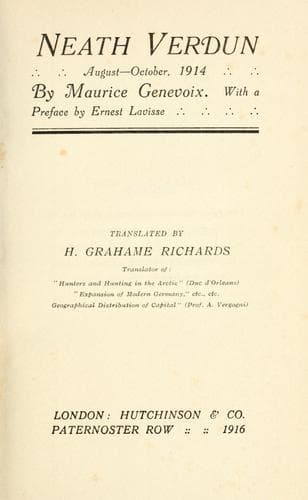
'Neath Verdun, August-October, 1914Genevoix, Maurice
History
'Neath Verdun, August-October, 1914
Genevoix, Maurice
Verdun, Battle of, Verdun, France, 1914
We are already installed, rifles racked along the sides of the barn,
when the battalion adjutant thrusts his face and pipe around our door.
I shall not attempt to set down the language that ensued; but,
briefly, we had to un-install ourselves. Farewell, thou golden-jellied
brawn, farewell!
We are set down for duty in the vicinity of a sawmill. Logs of timber
of equal lengths, planks already sawn, are piled outside the sheds. We
have to set a sentry, bayonet fixed, to help the cooks preserve the
timber from the depredations of those frail mortals who might be
tempted to help themselves and merrily burn the mill's stock. A
temptation not difficult to understand!
"And now," says Porchon to me, "we have got to fit ourselves out
again! There must surely be some precious things about here; but
perhaps in an hour or so they will carry them off."
There ensues the usual chase for rations. For that business one should
possess the scent of a hound to worry out obscure corners; and
diplomacy, to reach the hearts of these peasants and overcome their
hesitation--for they always hesitate, never freely parting with
whatever they may have for sale, hoping that another purchaser may
come along and offer more than you are offering.
A freemasonry which tends to mutual benefit exists among campaigning
comrades:
"Look here! Down that lane, the third house to the left, the one with
the green shutters, there is an old woman who sells eggs...."
Let us go and investigate! The old woman, horrible to look upon, dry
as the seared vine, toothless, filthy, untidy strands of grey hair
hanging about her face, raises her arm to the sky and calls upon the
Holy Virgin to witness that she has nothing, nothing at all.... We
mention a price, a ridiculous, extortionate figure. It is plain magic;
the arm drops instantly; her voice descends an octave; and then the
old miser glides along a passage-way thick with fowl-droppings, bends
her body to pass through a low doorway, emerges with caution, carrying
something in her apron. And when she approaches again, half a dozen
eggs are clutched in her claw-like hands--they are white as milk in
contrast with her dirty, lined palms. They are still warm when she
drops them into our pockets. In a lowered voice, with lips stiffly
drawn over her bare gums, she says:
"Do not tell anyone about it. Perhaps I shall have some more for you
when my hens have laid. But don't breathe a word about it. Mind, not a
word!"
Porchon has discovered some plum jam. Jam?--it is rather a compound of
quinces scarcely sweetened.
"I paid seven sous a quarter for this mixture," he informs me. "The
pigs who sold it to me had two enormous copper cans full of it on
their counter, and they emptied them in half an hour at the same
price."
Public-domain text, read in full here on John Shaqi.
Reviews
Reviews
No reviews yet
Be the first to share your thoughts on this work.
Elsewhere in the archive
Join the Discussion
Join the discussion
Sign in to leave a comment or review.
Sign InorCreate an account