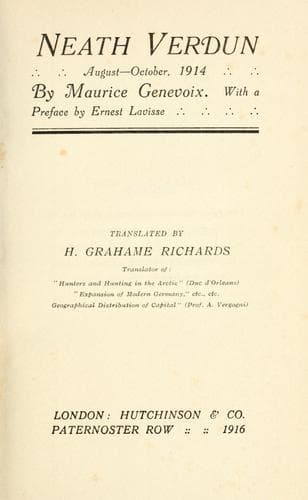
'Neath Verdun, August-October, 1914Genevoix, Maurice
History
'Neath Verdun, August-October, 1914
Genevoix, Maurice
Verdun, Battle of, Verdun, France, 1914
The robbers! Before the war, these quinces were left to ferment in
hogsheads. Each hogshead gave a few pints of brandy at forty sous, and
the pulp of the fruit was then thrown into the fire. It is not an
augury of good times ahead!
We dine with an old Alsatian woman, a neat clean old woman, rosy and
well preserved. She wears a bonnet, round and very white, so white
that never before in the whole Meuse district have I seen one quite so
chic and prepossessing. A doorway of bricks, newly washed, clean and
as red as one's face after a wash in cold water; furniture which
shines as does the top of the table covered with brown oilcloth. Above
the sink a brass bracket reflects the light of our lamp and sends a
pencil of light through the darkness.
"Cabbage soup!" announces Presle, "and after that we have roast fowl."
Oh! that roast fowl! A consumptive hen, a lamentable thing, lying on
its back in the middle of an immense dish. To the head with its closed
eyes was attached a body about as big as a fig, and the claws, which
Presle had neglected to remove, were crisp, black and contracted as
though in agony.
"It is certainly not a Bresse fowl," explains Presle in
self-extenuation. "And, at the same time, I believe that her
flirtations must have made a long-distance walker of her before I
wrung her neck. All the same, it is fowl."
After dining, I inspect a collection of shoes which the cyclist has
picked up, I know not where. It is difficult to make a selection:
these are too broad, those are too long; some are already worn;
others, which fit exactly and appear on first sight to be made of soft
yet solid leather, unexpectedly reveal a long cut. At length I choose
a pair with welted soles, newly clumped, of which the cyclist says:
"I guarantee them for six months without repair, Lieutenant. They will
carry you to the end of the campaign, of that you can be certain."
"Amen!" I replied.
We go out arm in arm, Porchon and myself. The night is not very dark.
The piles of planks near the sheds rise in dark, geometrical masses.
The village to the right is lightless and still; away to the left,
towards the cemetery, a pale mist broods over the fields. An
undulating line of willows marks the course of the stream which they
veil. The line continues to the foot of an abrupt slope, rising to the
south-east like a gigantic wall.
"Where are you taking me?" asks Porchon.
"Just wait a little and you will see."
We walk in silence, occasionally burying our feet in heaps of soft
ashes, which mark the spots where braziers have burnt.
"Point of direction, that isolated house," I explain, after a time.
"There are some steps and an iron railing. Hold on to me, old man! You
are going to see what you are going to see."
I take the stone steps in three jumps and knock at the door.
Children's voices die abruptly to silence, a step sounds over the
floor, the latch clicks, and the door opening wraps us in a gust of
warm air.
Public-domain text, read in full here on John Shaqi.
Reviews
Reviews
No reviews yet
Be the first to share your thoughts on this work.
Elsewhere in the archive
Join the Discussion
Join the discussion
Sign in to leave a comment or review.
Sign InorCreate an account