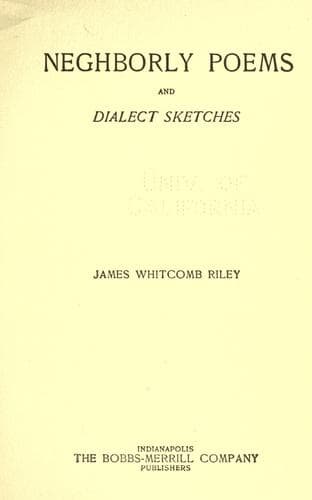
Neghborly Poems and Dialect SketchesRiley, James Whitcomb
General
Neghborly Poems and Dialect Sketches
Riley, James Whitcomb
Dialect literature, American; Dialect poetry, American
Produced by Juliet Sutherland, Diane Monico, and the Online
Distributed Proofreading Team at https://www.pgdp.net
NEGHBORLY POEMS
AND
DIALECT SKETCHES
JAMES WHITCOMB RILEY
INDIANAPOLIS
THE BOBBS-MERRILL COMPANY
PUBLISHERS
Copyright 1883, 1891 and 1897
By JAMES WHITCOMB RILEY
PRESS OF
BRAUNWORTH & CO.
BOOKBINDERS AND PRINTERS
BROOKLYN, N. Y.
TO MY BROTHER
HUMBOLDT RILEY
PREFACE
As far back into boyhood as the writer's memory may intelligently go,
the "country poet" is most pleasantly recalled. He was, and is, as
common as the "country fiddler," and as full of good old-fashioned
music. Not a master of melody, indeed, but a poet, certainly--
"Who, through long days of labor,
And nights devoid of ease,
Still heard in his soul the music
Of wonderful melodies."
And it is simply the purpose of this series of dialectic studies to
reflect the real worth of this homely child of nature, and to echo
faithfully, if possible, the faltering music of his song.
In adding to this series, as the writer has, for many years, been urged
to do, and answering as steadfast a demand of Benj. F. Johnson's first
and oldest friends, it has been decided that this further work of his
be introduced to the reader of the volume as was the old man's first
work to the reader of the newspaper of nearly ten years ago.
Directly, then, referring to the Indianapolis "Daily Journal,"--under
whose management the writer had for some time been employed,--from
issue of date June 17, 1882, under editorial caption of "A Boone County
Pastoral," this article is herewith quoted:
Benj. F. Johnson, of Boone county, who considers the Journal
a "very valubul" newspaper, writes to enclose us an original
poem, desiring that we kindly accept it for publication, as
"many neghbors and friends is astin' him to have the same
struck off."
Mr. Johnson thoughtfully informs us that he is "no edjucated
man," but that he has, "from childhood up tel old enough to
vote, allus wrote more er less poetry, as many of an albun
in the neghborhood can testify." Again, he says that he
writes "from the hart out"; and there is a touch of genuine
pathos in the frank avowal, "Thare is times when I write the
tears rolls down my cheeks."
In all sincerity, Mr. Johnson, we are glad to publish the
poem you send, and just as you have written it. That is its
greatest charm. Its very defects compose its excellence. You
need no better education than the one from which emanates
"The Old Swimmin'-Hole." It is real poetry, and all the more
tender and lovable for the unquestionable evidence it bears
of having been written "from the hart out." The only thing
we find to--but hold! Let us first lay the poem before the
reader:
Here followed the poem, "The Old Swimmin'-Hole," entire--the editorial
comment ending as follows:
Public-domain text, read in full here on John Shaqi.
Reviews
Reviews
No reviews yet
Be the first to share your thoughts on this work.
Join the Discussion
Join the discussion
Sign in to leave a comment or review.
Sign InorCreate an account