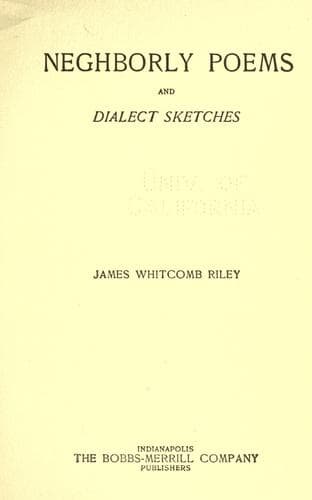
Neghborly Poems and Dialect SketchesRiley, James Whitcomb
General
Neghborly Poems and Dialect Sketches
Riley, James Whitcomb
Dialect literature, American; Dialect poetry, American
[These lines was writ, in ruther high sperits, jest at the close of
what's called the Anti Bellum Days, and more to be a-foolin' than
anything else,--though they is more er less facts in it. But some of
the boys, at the time we was all a-singin' it, fer Ezry's benefit, to
the old tune of "The Oak and the Ash and the Bonny Willer Tree," got it
struck off in the weekly, without leave er lisence of mine; and so
sence they's allus some of 'em left to rigg me about it yit, I might as
well claim the thing right here and now, so here goes. I give it jest
as it appeared, fixed up and grammatisized consider'ble, as the editer
told me he took the liburty of doin', in that sturling old home paper
THE ADVANCE--as sound a paper yit to-day and as stanch and abul as
you'll find in a hunderd.]
Come listen, good people, while a story I do tell,
Of the sad fate of one which I knew so passing well;
He enlisted at McCordsville, to battle in the South,
And protect his country's union; his name was Ezra House.
He was a young school-teacher, and educated high
In regards to Ray's arithmetic, and also Algebra:
He give good satisfaction, but at his country's call
He dropped his position, his Algebra and all.
"It's oh, I'm going to leave you, kind scholars," he said--
For he wrote a composition the last day and read;
And it brought many tears in the eyes of the school,
To say nothing of his sweetheart he was going to leave so soon.
"I have many recollections to take with me away,
Of the merry transpirations in the school-room so gay;
And of all that's past and gone I will never regret
I went to serve my country at the first of the outset!"
He was a good penman, and the lines that he wrote
On that sad occasion was too fine for me to quote,--
For I was there and heard it, and I ever will recall
It brought the happy tears to the eyes of us all.
And when he left, his sweetheart she fainted away,
And said she could never forget the sad day
When her lover so noble, and gallant and gay,
Said "Fare you well, my true love!" and went marching away.
But he hadn't been gone for more than two months,
When the sad news come--"he was in a skirmish once,
And a cruel Rebel ball had wounded him full sore
In the region of the chin, through the canteen he wore."
But his health recruited up, and his wounds they got well,
But whilst he was in battle at Bull Run or Malvern Hill,
The news come again, so sorrowful to hear--
"A sliver from a bombshell cut off his right ear."
But he stuck to the boys, and it's often he would write,
That "he wasn't afraid for his country to fight."
But oh, had he returned on a furlough, I believe
He would not, to-day, have such cause to grieve.
Public-domain text, read in full here on John Shaqi.
Reviews
Reviews
No reviews yet
Be the first to share your thoughts on this work.
Join the Discussion
Join the discussion
Sign in to leave a comment or review.
Sign InorCreate an account