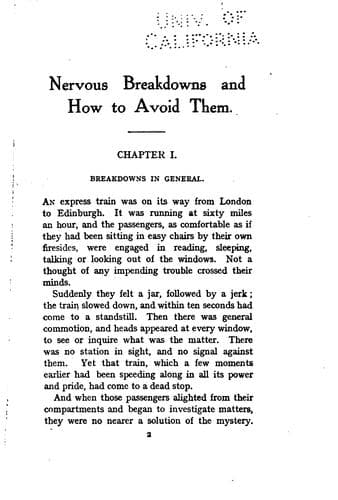
Nervous Breakdowns and How to Avoid ThemMusgrove, Charles David
Science
Nervous Breakdowns and How to Avoid Them
Musgrove, Charles David
Mental health
This will be only for a time, however, for the additional strain will
slowly but surely have a bad effect on the rest of the engine, and
through it on the other parts of the machine. One by one these will
give way, and have to be compensated in turn. If still neglected and
left to take care of itself, there will come a time when so many
sections are affected, that the remainder cannot overcome the mischief,
and compensation will fail. The car will become practically useless.
Perhaps, like the one-hoss shay, it will collapse _en masse_. It has
gone beyond the stage of running badly, it has broken down.
[Sidenote: The human machine.]
The human system is much like a motor-car, in that it consists of
a vast number of parts acting in unison. Yet it is infinitely more
wonderful, for it is much more complicated, and can create its own
supply of energy. It is made, roughly speaking, of a framework of
bone and muscle, a delicately-adjusted alimentary system, whereby it
takes in and assimilates food, and of a circulatory apparatus which
drives blood and nourishment to all parts of the body. It contains also
a nervous system, compared with which these other parts are crude,
mechanical contrivances. For it is on their nervous supply that they
depend for their usefulness. Cut the nerves that go to a limb, and the
finest muscles in the world are as helpless as the meat in a butcher’s
shop. Deprive the heart of its nerve supply for a single minute, and it
will never beat again.
Yet we pay vastly more attention to a weak heart, as it is called, or
still more so to a broken leg, than we do to a threatened failure in
the nervous system, which outweighs them all in importance. Once that
has got out of order, the driving power is gone. Not only the heart
and muscles, but every other faculty we possess loses its energy and
usefulness.
So closely allied, however, are the different parts, that the nervous
system itself, which governs all else, is dependent for its welfare on
the very organs it governs. Like the power of a king, it rests not only
on its own intrinsic qualities, but also on the strength and harmony of
the units over which it rules.
[Sidenote: Interplay.]
And there is a constant interplay going on between the various parts
of the body. No one organ or system can stand alone. If it is working
badly, it affects other parts, and disturbs the harmony on which the
health of the whole depends.
One of the most marked examples of this is to be found in the action
and reaction which take place between the digestive organs and the
nervous system. The presence of congenial company at meal-times is one
of the best aids to digestion; a cantankerous discussion is the very
opposite. Similarly, if a man sits down to his dinner with a grievance
or a worry on his mind, it is safe to predict dyspepsia.
Public-domain text, read in full here on John Shaqi.
Reviews
Reviews
No reviews yet
Be the first to share your thoughts on this work.
Join the Discussion
Join the discussion
Sign in to leave a comment or review.
Sign InorCreate an account