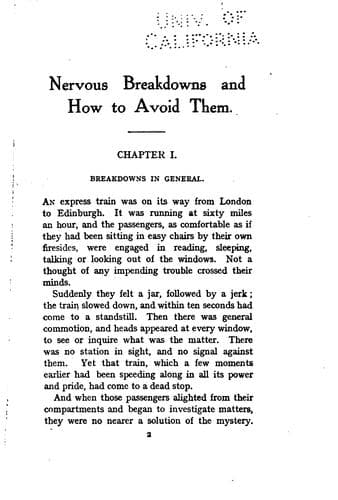
Nervous Breakdowns and How to Avoid ThemMusgrove, Charles David
Science
Nervous Breakdowns and How to Avoid Them
Musgrove, Charles David
Mental health
Without a sufficient quantity of liquids the waste matter in the
tissues is apt to become too condensed, and on this account less able
to reach the eliminatory organs, whose function it is to throw it off.
It not uncommonly happens that a man will consult a doctor, complaining
that he is suffering from pains in his limbs, either in the muscles or
the joints or both, also from a constant dull headache and sense of
tiredness. He fears that he is on the verge of rheumatic fever, and it
is not improbable that that is exactly what he is. On inquiry it turns
out that he has been in the habit of taking very little liquid either
with meals or between them. He is told to take an extra quart, two if
possible, a day. Then it often happens that in a week or two all his
symptoms have disappeared, and he is capable of as much exertion as he
ever was.
The liquid may be taken in any form, hot or cold, or in tea, coffee,
lemon water or any other beverage the person may prefer. It does not
matter how it is taken, so long as it gets into the system.
[Sidenote: Alcohol.]
So much has been written and spoken on the subject of alcohol, that it
would seem almost unnecessary to discuss it fully here. Ten or fifteen
years ago the necessity would have been vastly more pressing than it
is to-day. For no change is more remarkable than that which has come
over public opinion on this topic of recent years. For nearly a century
temperance reformers have been combating the moral effect of strong
drink. Then the medical aspect of the question came to the fore, and
the moderate drinker began to wonder if the matter did not apply to
himself as well as to the drunkard.
Excess is a matter of personal equation, and many men who have always
considered themselves strictly temperate have begun to realise that
while the amount they were taking was not sufficient to affect their
moral fibre, it was too much so far as their bodily health was
concerned. Consequently a welcome improvement has been manifest in the
drinking habits of the community. The growth of athletics has no doubt
had much to do with this change.
It may be, too, that the attitude of the medical profession has had a
share. Twenty or thirty years ago it was a dangerous thing for a doctor
to tell a patient to reduce his ration of alcohol. Now the profession
gives its orders on the point with as little hesitation as it exhibits
in ordering a diet. And the public has shown its appreciation of this
fact in the view it has taken. Once a doctor who did not order wine
during convalescence was looked upon as a faddist. Now he is regarded
as old-fashioned if he does so, unless there is some special reason for
it.
While reserving for every man the right of his own opinions as to
alcohol as a beverage, medical men rarely order it save as a drug, as
in the administration of brandy in acute illness.
Public-domain text, read in full here on John Shaqi.
Reviews
Reviews
No reviews yet
Be the first to share your thoughts on this work.
Join the Discussion
Join the discussion
Sign in to leave a comment or review.
Sign InorCreate an account