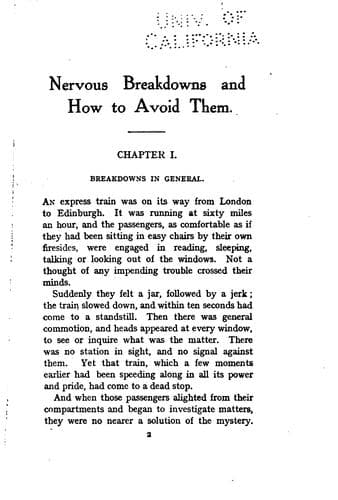
Nervous Breakdowns and How to Avoid ThemMusgrove, Charles David
Science
Nervous Breakdowns and How to Avoid Them
Musgrove, Charles David
Mental health
It is a true saying that worry, not work, kills. People can get through
an amazing amount of work if they do it in a quiet and methodical
manner.
One morning two men were walking along a road in the direction of a
railway station. One of them was going at a steady pace, with a look of
contentment about him, as if he were enjoying the walk. The other was
hurrying along with quick, nervous steps, occasionally looking at his
watch and breaking into a short run, while his strained expression and
panting breath formed a marked contrast to the easy deportment of his
friend.
They both caught the train, but while one was cool and collected and
felt invigorated for his work when he reached the terminus, the other
was hot and flurried, and this gave him a bad start for the day.
Moreover, each of them transacted his business in much the same way as
he had walked to the station, one doing it quietly and methodically,
while the other spent his time in rushing from one thing to another,
taking his lunch in the fewest possible minutes, and constantly
worrying himself and everyone else into the bargain.
The singular part of it was that the quiet, steady-going man got
through more work in the day than his friend did, and years later,
when they had reached middle age, was as fit as ever for his business,
whereas the other man was broken down by overwork, as he called it.
In the last chapter we considered the question of physical and mental
fatigue resulting from work. We purposely omitted the element of
worry, which does more harm than all the other conditions of work put
together. For worry does more than tire the mind--it demoralises it.
In a certain war two companies of men had to march an equal distance
in order to meet at a particular spot. The one arrived in perfect
order, and with few signs of exhaustion, although the march had been an
arduous one. The other company reached the place utterly done up and
disorganised. It was all a question of leadership: the captain of the
first company had known his way and kept his men in good order, while
the captain of the second company had never been sure of himself, and
had harassed his subordinates with a constant succession of orders and
counter-orders, until they had hardly known whether they were on their
heads or their heels. That was why they arrived looking completely
demoralised.
[Sidenote: Worry and the mind.]
Public-domain text, read in full here on John Shaqi.
Reviews
Reviews
No reviews yet
Be the first to share your thoughts on this work.
Elsewhere in the archive
Join the Discussion
Join the discussion
Sign in to leave a comment or review.
Sign InorCreate an account