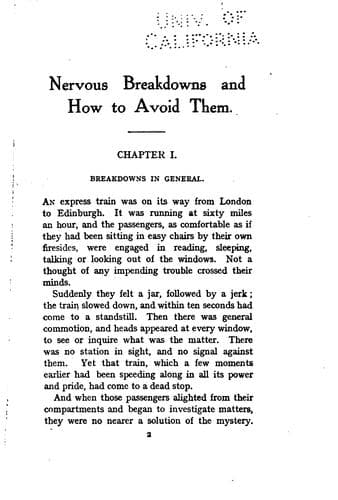
Nervous Breakdowns and How to Avoid ThemMusgrove, Charles David
Science
Nervous Breakdowns and How to Avoid Them
Musgrove, Charles David
Mental health
Equally significant is the langour that attacks people when they are
following their daily avocations. Of course, it is natural that as
people grow older they should find themselves less capable of exertion
than they were in their younger days. Most persons over forty years of
age have to take things somewhat more quietly than before. They are
not so well able to run, and perhaps have to walk more deliberately,
but that is very different from feeling fatigued when there has been
no justification for it. Yet even that is not a matter of such gravity
as when a man who has taken a keen interest in his daily work, of
whatever sort it may be, discovers that it is becoming more and more
of an effort. Or it may be a woman, who finds her household duties,
which had hitherto been a pleasure to her, becoming a bugbear. And when
anyone, either man or woman, begins to look forward habitually with
dread to the work of the following day, their health is in sore need of
attention.
[Sidenote: Worry.]
Yet in most cases all that they do is to reproach themselves for their
indolence and apply themselves to their duties still more assiduously,
with the usual result that they worry themselves and everybody else.
And the harder they try the worse things get, until at last the work
in which they had taken such a pride becomes a nightmare to them.
They begin to shrink from the thought of it, yet it forces itself
continually upon their notice. Perhaps even the evenings, which should
bring a sense of refreshing and repose, are spoiled by fretting over
the events of the day that is gone and worrying as to the work of the
morrow; the housewife in trepidation as to her duties in the home, the
workman to his job, the commercial man to his business, the parson to
his next appearance in the pulpit.
The result is that in many cases the work suffers.
Worry and anxiety are the common lot of mankind, at any rate in this
age of stress and competition. Yet it is not the common cares of life
which have a detrimental effect on the human system, but this useless,
exaggerated vexation of spirit. When a man has lost the power of
leaving his worries behind him, it is time that he began to take heed,
for sooner or later they will affect his work. If he allows himself
to drift, wasting his energies by futile struggling against his own
disabilities, his mental faculties will begin to show signs of wear and
tear.
[Sidenote: Memory.]
It may be that his memory will play him tricks, words and facts failing
him at the critical moments. There is no surer sign of neurasthenia
than when a man who has always been a ready speaker, begins to hesitate
for words in which to express himself. The worst symptom of all is when
people noted for their firm, decisive characters find themselves unable
to make up their minds, either on some subject of general interest or
on points connected with their own pursuits.
[Sidenote: Pleasures pall.]
Public-domain text, read in full here on John Shaqi.
Reviews
Reviews
No reviews yet
Be the first to share your thoughts on this work.
Join the Discussion
Join the discussion
Sign in to leave a comment or review.
Sign InorCreate an account