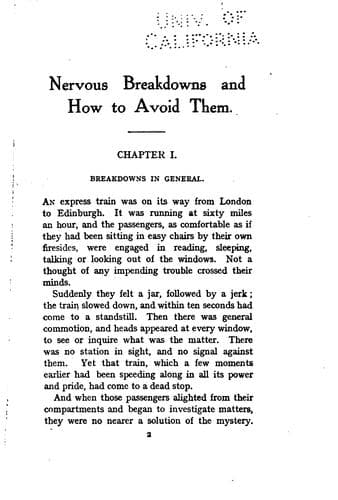
Nervous Breakdowns and How to Avoid ThemMusgrove, Charles David
Science
Nervous Breakdowns and How to Avoid Them
Musgrove, Charles David
Mental health
The man who walks and talks hurriedly or jerkily tends to think in
like fashion. Those whose minds are in a fume and a fidget usually
show it by fussing about and behave generally in a restless manner.
Let them force themselves to walk quietly and deliberately, and they
will be surprised to find how quickly their minds follow suit and
settle down into a steadier groove. And if they take care to speak in
the same deliberate fashion at the same time, the good effect will be
heightened. The movement of the limbs and of the lips react on the
mind to a surprising extent.
If any should doubt what we have said as to the close connection
between the body and the mind, let them try an experiment which was
advocated many years ago by a celebrated psychologist. It consists in
reading a comic book with the features contracted into a stern frown,
and following this up by reading a pathetic one with the face relaxed
into a broad grin. The result will convince them as to the truth of our
previous statements.
[Sidenote: Anticipation.]
Sometimes a man is worried to death on account of some event he is
anticipating, a reply to some letter he has sent, or the news of some
appointment he is in for. Often under such circumstances he will pace
up and down like a caged beast, until the nervous tension almost makes
him ill. Try as he may, he cannot sit still. But he can do something
equally efficacious, he can engage in some other occupation, keeping
his hands and mind employed, instead of glancing continually at the
clock or looking for the postman.
[Sidenote: Beset by work.]
And sometimes people are beset by business until they scarcely know
where to turn. Then it may be that they become so agitated that they
can do nothing to further the matter in hand. A man once consulted
a doctor as to an experience that had befallen him on the previous
evening. “At teatime,” he said, “I found myself becoming anxious and
worried as to the amount of work in front of me. And the harder I tried
to get on with it the more obstinately my brain refused to act, and by
bedtime I had got everything into a hopeless muddle.”
The doctor told him that curiously enough he himself had had a similar
experience the same evening, and just about the same time.
“And what did you do?” the patient inquired, and was much astonished
when the medical man replied, “Went out, had a couple of games of
billiards, then came back and finished it all comfortably in a couple
of hours.”
When a man finds that his work is worrying him unduly, or when he is so
overwhelmed by it that he cannot keep his mental equilibrium, the best
thing he can do is to stop it for a time and have a rest or a change of
some sort, even if it is only for a few minutes. It will facilitate the
work in the long run, and will save the nervous system from an amount
of wear and tear which may take days or weeks to put right again.
Public-domain text, read in full here on John Shaqi.
Reviews
Reviews
No reviews yet
Be the first to share your thoughts on this work.
Elsewhere in the archive
Join the Discussion
Join the discussion
Sign in to leave a comment or review.
Sign InorCreate an account