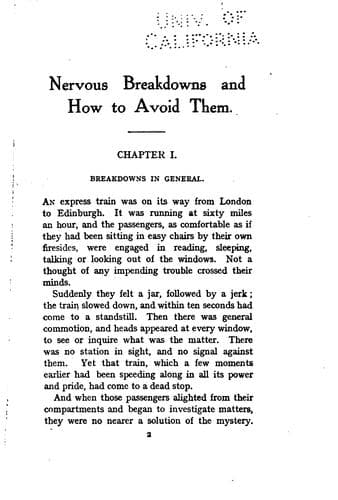
Nervous Breakdowns and How to Avoid ThemMusgrove, Charles David
Science
Nervous Breakdowns and How to Avoid Them
Musgrove, Charles David
Mental health
With worries of this sort we have no sympathy. They can be overcome
by an effort of will, and those who give way to them had better
realise that they are not only bothering the people around them, but
endangering their own nervous systems as well. For worry leads to
worry. A mind that is addicted to them will always tend to distort
things, making mountains out of molehills. Objects invariably loom
larger in a fog.
And of all troubles in this life there are none so hard to bear as
imaginary ones. Many of us prefer to meet a burglar rather than a
ghost. The troubles we dread rarely come. Yet the strain of thinking
about them tends to precipitate other disasters. The man who is always
on the look-out for orange peel is very liable to run his head against
a lamp-post. If after that he is always thinking of lamp-posts, he is
almost certain to slip on a piece of orange peel. And people who are
constantly worrying about the future, and all the ills that it may
bring with it, are inviting troubles, for they are frittering their
energies instead of applying them to their work.
[Sidenote: Worry and neurasthenia.]
Worry is a potent factor in causing neurasthenia, and once that has
come about the system is deprived of its resisting power and laid open
to disease. And neurasthenics are singularly prone to forebodings.
The state of the nervous system alters the circulation in the body to
such an extent that it is apt to cause the feeling of illness, if not
illness itself. Such people are liable to feel chilly or burning hot,
even though their temperatures may be normal. Yet because of their
sensations they feel certain that they are going to be ill, and the
dread of this still further aggravates their nervous condition.
While worry brings on neurasthenia, the latter adds to worry. The whole
process is like a snowball rolling down a hill, increasing in size as
it does so. All the more reason, therefore, why we should take every
precaution to arrest it at the outset, by considering in what way
worry can be prevented.
[Sidenote: How to prevent worry.]
This can never be done by running away from responsibilities or
difficulties of any sort. Such as they may be, we must face them.
There are many people to-day, as in the ancient time, who sigh for the
wings of a dove that they may fly away and be at rest. Even if they
got the wings, it is doubtful if they would be much better off. In all
probability they would find that they had gone farther only to fare
worse.
Neither can worry be got rid of by sitting down and trying to make up
our minds that we will not give way to it. The seasick man might as
well command the waves to be still. We have little direct control over
the nervous system, but we have a vast amount of influence over the
movements of the body, which reacts in such a pronounced manner on the
mind.
[Sidenote: Body and mind.]
Public-domain text, read in full here on John Shaqi.
Reviews
Reviews
No reviews yet
Be the first to share your thoughts on this work.
Elsewhere in the archive
Join the Discussion
Join the discussion
Sign in to leave a comment or review.
Sign InorCreate an account