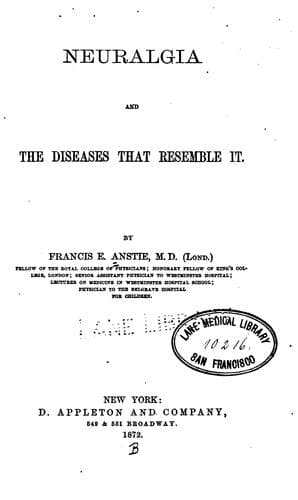
Neuralgia and the diseases that resemble itAnstie, Francis Edmund
Science
Neuralgia and the diseases that resemble it
Anstie, Francis Edmund
Neuralgia
hearing, I have noticed serious impairment only in five cases, all of
them of a severe type of trigeminal neuralgia, involving all three
divisions of the nerve. Smell, I have never observed to be more than
doubtfully impaired, except in one case (_vide_ Chapter III), where it
was completely destroyed.
Common sensation was reported by Notta as affected in only three cases
out of a hundred and twenty-eight; but my own experience has afforded a
much larger proportion of instances in trigeminal neuralgia. Indeed, in
all situations neuralgia appears to me to involve this effect, in the
larger number of instances, in the early stages; later, it is supplanted
in part by great tenderness on pressure in the well known _points
douloureux_, and sometimes the tenderness becomes diffused over a
considerable surface. I agree with Eulenburg in thinking that anæsthesia
is more frequent in sciatica than in other neuralgias.
6. Secretion is often very notably affected in neuralgia; the phenomena
are necessarily more easily observed in connection with affections of
the trigeminal than of other nerves. In the great majority of cases the
affection is in the direction of increase; at least, the watery elements
of secretion are often poured out in profusion. Thus, profuse
lachrymation is exceedingly common in ophthalmic neuralgia; in a large
number of cases there is also copious thin nasal flux on the affected
side; sometimes, however, the secretion, though copious, is
semi-purulent, or bloody. Increased salivation has been noticed, by a
large number of observers, in neuralgia involving the lower division of
the fifth. In a smaller number of instances, the secondary effect on
secretion is precisely opposite; thus both Notta and myself have
observed complete dryness on the nostril on the affected side in
ophthalmic neuralgia.
I might expand this chapter on the complications of neuralgia to a very
much greater length; but, as regards the clinical history of these
affections, it is perhaps better not to occupy more time and space. It
will, however, be necessary to return to the consideration of the
subject in connection with Pathology.
FOOTNOTE:
[15] Archiv fur Ophthalmologie, B. xii., Abth. 1, 1866.
CHAPTER III.
PATHOLOGY AND ETIOLOGY OF NEURALGIA.
The pathology and the etiology of neuralgia cannot be considered apart;
they must be discussed together at every step. I do not mean to say that
neuralgia is singular among diseases in this respect; it seems to me
merely a case in which the intrinsic defects of the conventional system
of separating the "causes" of disease from its pathology happen to be
more glaring and more easily demonstrable than usual.
Public-domain text, read in full here on John Shaqi.
Reviews
Reviews
No reviews yet
Be the first to share your thoughts on this work.
Elsewhere in the archive
Join the Discussion
Join the discussion
Sign in to leave a comment or review.
Sign InorCreate an account