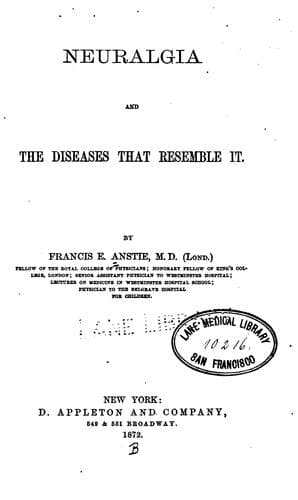
Neuralgia and the diseases that resemble itAnstie, Francis Edmund
Science
Neuralgia and the diseases that resemble it
Anstie, Francis Edmund
Neuralgia
Among the convulsive affections must be reckoned convulsive movements
and tonic spasms of various portions of the alimentary canal. Vomiting
is a common example of this; in migraine it is the regular and necessary
climax of attacks which last with severity for a certain time; indeed,
any severe attack of neuralgia involving the ophthalmic division of the
fifth may excite vomiting. Convulsive action of the pharyngeal muscles,
as a complication of pharyngeal or laryngeal neuralgia, occasionally
occurs to such an extent as to render deglutition difficult or
impossible for the time. And I have seen what I do not doubt to have
been a spasmodic condition of the rectum induced by peri-uterine
neuralgia. The genito-urinary organs are also not unfrequently affected
spasmodically in consequence of a neuralgic affection either
peri-uterine or pudendal. I have seen spasmodic stricture of the male
urethra thus produced, and likewise vaginal spasm.
5. Impairments of sensation, both common and special, are very frequent
attendants of neuralgia. As regards the special sensations, we may first
mention that of touch; this is almost constantly impaired, immediately
before, during, and some little time after a neuralgic paroxysm, in the
skin supplied by the painful nerves. I was first led to make this
observation by my own experience; the skin all round the inner angle of
my right eye is permanently less sensitive to distinctive impressions
than that of the opposite side, and this impairment is always decidedly
greater, and spreads over a larger surface, before, during, and for some
time after, the attacks of pain. More extended observation has convinced
me that a certain amount of bluntness of distinctive skin-sensation
accompanies nearly every neuralgia. As regards the sense of taste, I
have found this decidedly perverted, at the time of an attack, even in
my own case, although the neuralgia never extends into the third branch
of the nerve. It is interesting to notice, in connection with this,
that the epithelium of my tongue has been seen, on one occasion, to be
exaggerated on the side of the neuralgic affection, showing a
probability that there is perturbed function, at any rate of certain
fibres, of the third division. But I have seen much more decided
alteration, indeed temporary entire abeyance of the power to distinguish
between the tastes of different substances, with the affected side of
the tongue, in a case of severe epileptiform tic in which the third
division was strongly affected with neuralgia; and Notta records a
similar instance. As regards vision, besides minor perversions and
disturbances, I have observed more or less complete amaurosis in several
instances of ophthalmic neuralgia; in one case it was absolute, and
lasted, with but slight improvement in the intervals between the
paroxysms, for nearly a month, but disappeared entirely, though somewhat
gradually, after the final cessation of the neuralgia. As regards
Public-domain text, read in full here on John Shaqi.
Reviews
Reviews
No reviews yet
Be the first to share your thoughts on this work.
Elsewhere in the archive
Join the Discussion
Join the discussion
Sign in to leave a comment or review.
Sign InorCreate an account