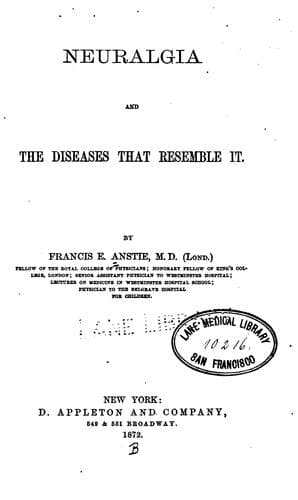
Neuralgia and the diseases that resemble itAnstie, Francis Edmund
Science
Neuralgia and the diseases that resemble it
Anstie, Francis Edmund
Neuralgia
XX. Sciatica; in a lady, aged sixty; second attack. Ancestors, on
both sides, for some generations, clever, and in several
instances decidedly eccentric, if not insane; much neuralgia
in the family.
XXI. Migraine; in a young lady, aged seventeen; menstrual
difficulties. No neurotic nor phthisical family history.
XXII. Sciatica; in a married lady, aged twenty-seven; first pregnancy;
had rheumatic fever and subsequent chorea in childhood. Paternal
uncle epileptic; mother had rheumatic fever and cardiac disease;
paternal grandfather suffered from sciatica late in life.
No one, I think, can look down the above list and fail to be struck with
the great preponderance of cases in which the general neurotic
temperament plainly existed in the patients' families; and let me add
that, in not a few of these cases, the neuralgia in the individual under
observation might have been easily set down as dependent merely upon
peripheral irritation, which, indeed, plainly did act as a concurrent
cause.
Fortunately, however, I am not dependent upon my own evidence alone, for
the proofs of the proposition that neuralgia is eminently a development
of hereditary neuroses. The great French alienists, Morel and Moreau of
Tours, some years ago laid the foundations of the doctrine of hereditary
neurosis. They enforced this chiefly with reference to the manner in
which insanity is transmitted through a chain of variously-neurotic
members of a family stock; and Moreau laid special stress on the deeply
interesting connection of the phthisical with the neurotic tendency.
Since then various observers have insisted on the same thing. Of late,
Dr. Maudsley has worked out this subject with great ability, in his work
"On the Physiology and Pathology of Mind," and in his recent "Gulstonian
Lectures;" and Dr. Blandford dwells on it with emphasis in his
interesting "Lectures on Insanity." [Dr. Blandford does not, however,
admit that the phthisical diathesis has any such close and causal
relation with neuroses as has been imagined by some recent pathologists;
and, on the other hand, he points out that phthisis in neurotic
subjects, _e. g._, the insane, must, in a large measure, be considered
the product of the accidentally unhealthy circumstances in which they
pass their lives. In the latter opinion I entirely agree.] Indeed, it
may be taken as a recognized fact, among the more advanced students of
nervous diseases, that hereditary neurosis is an important antecedent of
neuralgia, in at least a very large number of instances. I shall
conclude this part of the argument by stating the general results of my
inquiries respecting sixty-one hospital patients. Of these cases,
twenty-two were migraine, or some other affection of the ophthalmic
division of the fifth nerve; seven were sciatica; two were epileptiform
facial tic; ten were neuralgias affecting chiefly the second and third
Public-domain text, read in full here on John Shaqi.
Reviews
Reviews
No reviews yet
Be the first to share your thoughts on this work.
Elsewhere in the archive
Join the Discussion
Join the discussion
Sign in to leave a comment or review.
Sign InorCreate an account