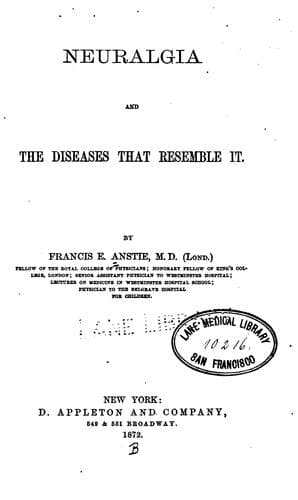
Neuralgia and the diseases that resemble itAnstie, Francis Edmund
Science
Neuralgia and the diseases that resemble it
Anstie, Francis Edmund
Neuralgia
divisions of the fifth nerve; three were intercostal neuralgias pure;
one was intercostal neuralgia plus anginoid pain; seven were intercostal
neuralgias with zoster; three were brachial neuralgias; and five were
abdominal neuralgias (hepatic, gastric, mesenteric, etc.) Of
eighty-three hospital and private patients [It must be understood that
the respective numbers do not indicate with any accuracy the relative
frequency of the different neuralgias as seen in my practice. (Sciatica,
_e. g._, was proportionally more frequent.) They represent but a small
part of the neuralgic patients whom I have seen during fourteen years of
dispensary, hospital, and private practice, and they were selected for
inquiry merely because I happened to be able to give the time for the
necessary questions. Every one who knows out-patient practice will
understand how seldom this happened.] I obtained evidence of the
presence, among blood-relations, of the following diseases: Epilepsy,
fourteen cases (eight were examples of migraine); hemiplegia or
paraplegia, nine cases; insanity, twelve cases; drunken habits, fourteen
cases; "consumption," eighteen cases; "St. Vitus's dance," four cases.
I am well aware that these figures must be taken with caution, and that
considerable doubt must rest on the accuracy of some of these details,
more especially with regard to "epilepsy," as it was impossible, with
the greatest care, to be sure that this was not given, by mistake, for
hysteria in some cases; and the same may apply to the statement that
relations had suffered from "consumption." The facts are given for what
they are worth, and with the express reservation that their total
reliability is far less than that of the accounts obtained respecting
private patients belonging to the more educated classes. But, in one
respect, viz., as regards drunken habits, it is possible that a truer
estimate is gained from the statements of hospital patients than from
those of private patients, who would usually be more prone to reticence
on such a topic.
Public-domain text, read in full here on John Shaqi.
Reviews
Reviews
No reviews yet
Be the first to share your thoughts on this work.
Elsewhere in the archive
Join the Discussion
Join the discussion
Sign in to leave a comment or review.
Sign InorCreate an account