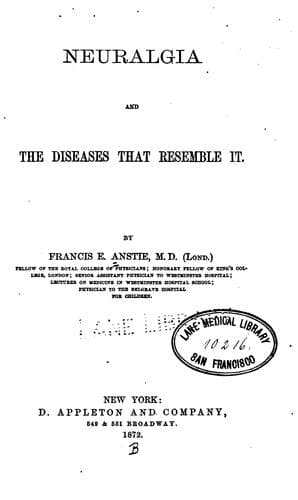
Neuralgia and the diseases that resemble itAnstie, Francis Edmund
Science
Neuralgia and the diseases that resemble it
Anstie, Francis Edmund
Neuralgia
The evidence as to the hereditary character of neuralgia assumes a yet
higher importance when supplemented by the facts respecting the
alternations of neuralgia with other neuroses as the same individuals.
Every practitioner must be aware how frequent is the latter occurrence.
Nothing is more common, for example, than to see insanity developed as
the climax of minor nervous troubles, especially of neuralgia. And there
is one form of neuralgia, the true epileptiform tic, which is intimately
bound up with a mental condition of the nature of melancholia, and even
with the markedly suicidal form of the latter affection. I have lately
had under my care a lady in whom the prodromata of a severe facial
neuralgia were mental; the disturbance commenced with frightful dreams,
and there was great mental agitation even before the pain broke out;
this disturbance of mind, however, continued during the whole period of
the neuralgia, and was relieved simultaneously with the cessation of the
attacks of pain. This is contrary to what happens in some cases; thus,
Dr. Maudsley quotes the case of an able divine who was liable to
alternations of neuralgia and insanity, the one affection disappearing
when the other prevailed. Dr. Blandford has met with several instances
in which neuralgia has been followed by insanity, the pain vanishing
during the mental disturbance, and reappearing as the latter passed
away. And he remarks that, in the transition of a neuralgia (to mental
affection), we may well believe that the neurotic affection is merely
changed from one centre to another, from the centres of sensation to
those of mind. He says that the ultimate prognosis of such cases is bad;
a point to which we shall have to refer again.
The prominent place which quasi-neuralgic pains hold in the earlier
history of locomotor ataxy is a fact that cannot but engage attention.
In this volume we have not treated these pains as belonging to the truly
neuralgic class, for the very practical reason that they are but
incidents in a most important organic disease, and that in a diagnostic
and prognostic point of view it is necessary to dwell on their
connection with that disease. But, in considering the pathological
relations of neuralgia, it would be improper to omit the consideration
of the pains of locomotor ataxy, which bear a striking semblance to
neuralgic pains. The fact that they are an almost if not quite constant
feature of a disease which is from first to last an atrophic affection
(mainly of the posterior columns of the cord), in which the posterior
roots of the nerves are almost always deeply involved, has a bearing on
our present inquiry too obvious to need further remark.
Public-domain text, read in full here on John Shaqi.
Reviews
Reviews
No reviews yet
Be the first to share your thoughts on this work.
Elsewhere in the archive
Join the Discussion
Join the discussion
Sign in to leave a comment or review.
Sign InorCreate an account