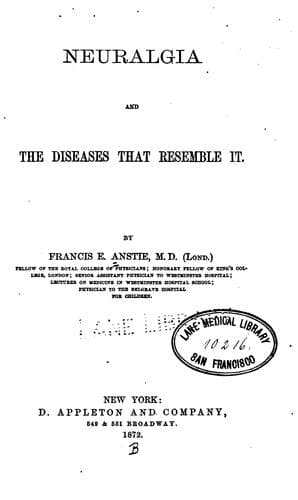
Neuralgia and the diseases that resemble itAnstie, Francis Edmund
Science
Neuralgia and the diseases that resemble it
Anstie, Francis Edmund
Neuralgia
already seen, is peculiarly favorable to the formation of the neurotic
habit, and I must emphatically state my belief that among the
seriously-minded English middle classes, more especially, whose life is
necessarily colorless and monotonous, the mischief thus worked is both
grave and widely spread.
Perhaps the maximum of damage that can be inflicted through the mind
upon the sensory nervous centres is effected when to the kind of
self-consciousness that is generated by an excessive spiritual
introspection there is added the incessant toil of a life spent in
sedentary brain-work, and checkered with many anxieties, and many griefs
which strike through the affections. Doubtless, such a combination of
morbid mental influences is sufficient of itself to generate the
neuralgic disposition in its severest forms, without any hereditary
neurotic influence, and without any other peripheral irritations; I have
more than one such instance in my mind at this moment. But, if they can
do this, much more can such influences arouse inherent tendencies to
neuralgia; to persons who are predisposed in this manner they are most
highly deleterious.
3. We come now to the peripheral influences which in a more obvious
manner become factors in the production of neuralgia. Of such influences
there are an immense variety, and the only common quality that can be
predicated of all is the tendency directly to depress the life of the
sentient centre upon which their action impinges.
If we search among the external influences which contribute to the
production of neuralgia for one that is apparently trivial as to the
amount of material disturbance which it can cause, and yet is very
frequently effective, we may select the agency of cold. The effect of a
continuous cold draught of air impinging on the naked skin for some time
is comparatively frequently seen in the provocation of neuralgic attack:
we say comparatively, because this influence is more frequently
effective than blows, wounds, or temporary irritations of any kind,
applied to the peripheral ends of sensory nerves. But if neuralgia be a
more frequent consequence of cold than of these other influences, a
moment's reflection will show that it is by no means an absolutely
common result. One has only to think of the numerous omnibus-drivers,
engine-drivers, cab-drivers, etc., etc., who pass their whole working
lives in presenting the (more or less) naked expanse of their trigeminal
and their cervico-occipital nerves to every variety of wind, to perceive
that, were this sort of influence very potent in itself, male neuralgic
patients should swarm as thick as bees in our hospital and dispensary
out-patient rooms; which is notoriously quite contrary to the fact. The
same remarks, in both directions, may be applied to the direct influence
of atmospheric moisture, either with or without the effect of wind (of
course I am not speaking of the more recondite effects of damp soil on
the persons who live about it).
Public-domain text, read in full here on John Shaqi.
Reviews
Reviews
No reviews yet
Be the first to share your thoughts on this work.
Elsewhere in the archive
Join the Discussion
Join the discussion
Sign in to leave a comment or review.
Sign InorCreate an account