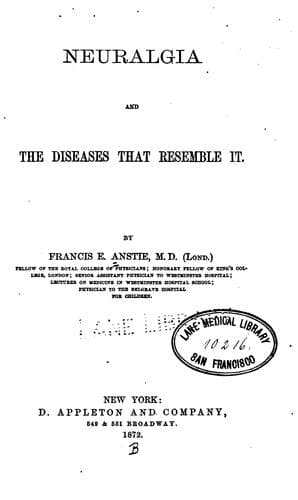
Neuralgia and the diseases that resemble itAnstie, Francis Edmund
Science
Neuralgia and the diseases that resemble it
Anstie, Francis Edmund
Neuralgia
[Among the hundred patients who formed
the basis of the inquiries mentioned in this work, forty-one accused
external cold of producing the attack, but many of these produced
insufficient evidence that such was the case.] In short, the direct
effects of atmospheric cold would seem to be these. Mere lowness of
temperature goes for something, but not much; [The most marked instance
of the effect of cold, _per se_, that I have seen, was exhibited by a
young lady who was under my care during the past severe winter
(1870-'71). During much of the time she was confined to a
carefully-warmed apartment, on penalty of a violent paroxysm if she left
it.] for about as much, perhaps, as it does in the way of aggravating
all neurotic tendencies. Cold joined with wind is much more powerful.
And the maximum of ill-effect seems reached by very cold wind mingled
with sleet or driving rain, which keeps the skin sodden. But the
conclusion at which I long ago arrived is, that none of these influences
ever take more than a small (though it is sometimes an important) part
in the production of neuralgia; and that in the majority of cases there
is no pretence for supposing that they had the slightest share in its
causation.
A word or two must be said as to the _modus operandi_ of cold and cold
wind, as these are the most frequent of external, so-called "exciting"
causes. The popular use of such phrases as the latter has an
extraordinary influence in disguising the plain fact, which is, that
these influences operate wholly in the direction of robbing the nerves
of force. The continuous abstraction of heat from the surface, which of
course is materially aided by rapid movement of the air, must
necessitate a readjustment of the distribution of energy, the only
result of which must be to drain the sensory nervous centre of its
reserve of force. But, in fact, there is an experiment, ready performed
to our hands, which may amply satisfy us as to the kind of influence
exerted by cold on superficial nerves, viz., the sensations experienced
in recovering from frost-bite, which has been severe enough to paralyze
the nerves without causing actual gangrene of the tissues. The passage
of the nerves back from temporary death to full functional life is
marked by a half-way stage in which there is agonizing pain.
4. We must next consider the effects of a class of peripheral influences
which act, where they exist, in a more constant manner than any others;
viz., those in which the trunk or periphery of a sensory nerve either
receives a severe injury, or becomes more or less engaged in
inflammatory processes, or compressed or otherwise damaged by the growth
of tumors or the spread of destructive ulcerations.
Public-domain text, read in full here on John Shaqi.
Reviews
Reviews
No reviews yet
Be the first to share your thoughts on this work.
Elsewhere in the archive
Join the Discussion
Join the discussion
Sign in to leave a comment or review.
Sign InorCreate an account