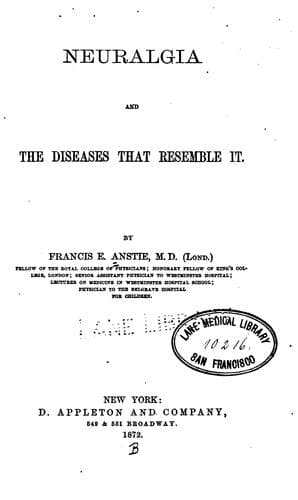
Neuralgia and the diseases that resemble itAnstie, Francis Edmund
Science
Neuralgia and the diseases that resemble it
Anstie, Francis Edmund
Neuralgia
The case of the neuromata is well worth reflecting upon, in the course
of our endeavors to clear up the Pathology and Etiology of Neuralgia. If
ever we could find a merely peripheral influence which would of itself
be invariably competent to excite neuralgic pains, it would surely be
found in neuroma; but the case is not merely not so, it is strikingly
contrary. Just as wounded and inflamed nerves frequently go through the
whole processes of disease and recovery without once eliciting a
neuralgic pang, so is it with neuromata; they are not unfrequently quite
indolent, and neither excite neuralgia, nor are themselves at all
particularly tender to the touch. And what is most remarkable is, that,
as Eulenburg correctly remarks, among the pseudo-neuromata the kind of
tumor which is most frequently associated with neuralgia is by no means
the dense fibroma or glioma, which might be expected by its mechanical
pressure to excite inevitable neuralgic pain, but the far softer and
more yielding cystic tumors. I do not know how the facts may affect the
reader, but to me they suggest the strongest possible arguments against
the belief that peripheral irritation can of itself produce neuralgia
without the intervention of some centric change. The tendency to such
change (from inherent constitution) in the sensory root of the nerve
must surely be the reason why neuroma causes neuralgia in a given number
of subjects, instead of letting them go scot-free, as it does other
persons.
The same remarks apply to the result of observations on the effect of
tumors commencing in tissues altogether unconnected with the nerve, and
merely coming to involve it, secondarily, in pressure. It has been often
noted that, among these tumors, fluid-containing cysts and soft
medullary cancers are far more frequently the cause of decided and
distressing neuralgia than the denser and less yielding neoplasms. Of
kinds of tumors that are specially apt to produce severe and even
intolerable neuralgia by the pressure on nerves, it has been remarked
that aneurisms are among the worst: here every pulsation often sends a
dart of agony through the nerve. There is a reason here, however, which
is often left out of sight; not merely is the perpetually varying
pressure specially harassing and exhausting to the nerve, but in many of
these cases there is general arterial degeneration, and the sensory root
of the nerve is exceedingly likely to be very badly nourished. [This
result will be more directly brought about when the aneurism happens to
press on the ganglion of a posterior root.] We pass now to the
consideration of the influence exerted by other great series of
peripheral impressions in the production of neuralgia. These impressions
are connected chiefly with the functions of the digestive and of the
genito-urinary organs, the functions of the eye, and the nutrition of
the teeth.
Public-domain text, read in full here on John Shaqi.
Reviews
Reviews
No reviews yet
Be the first to share your thoughts on this work.
Elsewhere in the archive
Join the Discussion
Join the discussion
Sign in to leave a comment or review.
Sign InorCreate an account