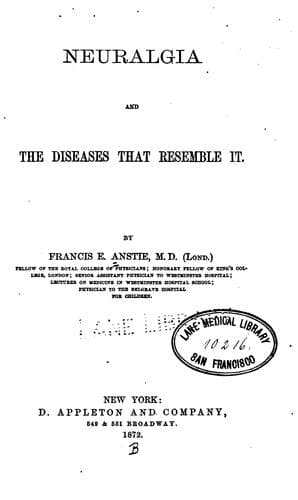
Neuralgia and the diseases that resemble itAnstie, Francis Edmund
Science
Neuralgia and the diseases that resemble it
Anstie, Francis Edmund
Neuralgia
With regard to ordinary nerve-wounds as a cause of neuralgia, we have
already said (_vide_ Chapter II.) nearly as much as it is necessary to
say; we need only here point out that, like the influence of cold
applied to superficial nerves, that of wounds must necessarily be a
depressing one to the centre with which the wounded nerve is connected,
and the resulting neuralgia must be regarded as an expression of impeded
and imperfect nerve-energy, not of heightened nerve-function. The pain
is set up during the process of nerve-healing; that is to say, at a
stage intermediate between those of abolished function and completely
restored function; and there can be little doubt that the obstinacy with
which it is often protracted is due to the slowness with which a wounded
nerve recovers its full functional activity; when once the latter is
completely restored there is an end of neuralgic pain. It is exactly
analogous to the course of events in recovery from freezing.
There remain for consideration, however, (a) a small class of cases of
nerve-wounds in which the healing process is not simple; but the lesion
is followed by the development of a tumor of the kind denominated true
neuroma. The process consists of hyperplastic changes in the
nerve-fibres; its commonest examples are seen in the extraordinarily
painful swellings that occur on the ends of nerves left in stumps after
amputations; but, in fact, a neuroma of this kind may occur after any
kind of severe nerve-injury, as, _e. g._, a cut from broken glass, the
impaction of foreign bodies, etc. The true neuromata are composed mainly
of nerve-tissue, with a relatively small element of connective tissue:
the nerve-fibres can be traced directly to the nerve-tumor. Besides the
traumatic neuromata which form permanent tumors, incapable of being got
rid of except by actual excision, a minor variety of the same kind of
change has in several cases been known to take place in consequence of
an abiding local irritation from the impaction of a foreign body, on the
removal of which the neuromatoid enlargement completely disappeared. (b)
There are likewise a certain number of cases in which a tumor is
developed from the neurilemma, and does not consist of nervous tissue;
these are distinguished as false neuromata, and may be of various kinds,
the fibromatous and gliomatous being far the most common, but cysts and
cystic tumors also sometimes occurring.
Public-domain text, read in full here on John Shaqi.
Reviews
Reviews
No reviews yet
Be the first to share your thoughts on this work.
Elsewhere in the archive
Join the Discussion
Join the discussion
Sign in to leave a comment or review.
Sign InorCreate an account