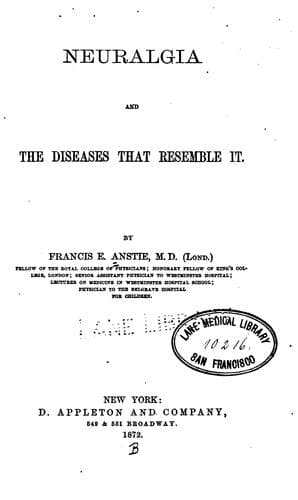
Neuralgia and the diseases that resemble itAnstie, Francis Edmund
Science
Neuralgia and the diseases that resemble it
Anstie, Francis Edmund
Neuralgia
6. The question how far, and in what way, the neuralgic tendency is
helped by certain constitutional diatheses, such as rheumatism and gout,
and by certain toxæmiæ, such as malaria, alcoholism, lead-poisoning,
etc., is a very much more difficult one than might be supposed from the
off-hand manner in which many writers speak of the "rheumatic," the
"gouty," or the "alcoholic" forms of "neuralgia." We may, however,
simplify it a good deal. In the first place, it seems obvious to me that
the only manner in which alcohol helps the production of true neuralgia
is by its tendency, after long abuse, to produce degeneration of the
nervous centres: it will therefore be considered, shortly, under another
division of the present subject. Lead-poisoning, again, only produces so
highly special a form of neuralgia (if colic be neuralgia at all) that
it need not detain us here. The influence of malaria is, for the most
part, an utter mystery to us, but by so much as we can see it appears
plain that one of the most important features in the disease is a
powerful disturbance of the spinal vaso-motor centres. But the most
interesting consideration that we have to deal with is the question of
the supposed relations of the rheumatic and the gouty diatheses, and the
syphilitic dyscrasia, to the neuralgic tendency. On this point I am
obliged to disagree _in toto_ with the popular view that assigns these
diatheses among the most frequent predisposing causes of neuralgia.
To take the case of rheumatism first, I am willing to allow that there
are a number of facts which superficially appear to countenance the idea
of a close connection of this disease with neuralgia. But of these facts
a considerable proportion consist only of examples of inflammation of
the nerve-sheath, with a certain amount of effusion within and around
it, occurring in persons who have never shown any symptoms which warrant
the assumption of a general rheumatic diathesis; and these local
phenomena really differ in nothing from many trophic and vaso-motor
changes which have been already described as plainly secondary to
ordinary neuralgia in which there could be no pretence of a rheumatic
pathology except on the slender foundation of a suspicion that the
affection was immediately excited by the influence of cold, which is
really no argument at all. Such patients will be found to have
exhibited, not special rheumatic, but special neuralgic tendencies in
their past history. On the other hand, there undoubtedly are a certain
number of patients who, having previously given signs of a tendency to
generalized rheumatic inflammation of fibrous membranes, are, on some
particular occasion, attacked with similar inflammation extending over a
more or less considerable tract (not a small limited spot) of a nerve
sheath. But so far from agreeing with those who think that this is a
frequent case, my experience teaches me that it is quite exceptional;
Public-domain text, read in full here on John Shaqi.
Reviews
Reviews
No reviews yet
Be the first to share your thoughts on this work.
Elsewhere in the archive
Join the Discussion
Join the discussion
Sign in to leave a comment or review.
Sign InorCreate an account