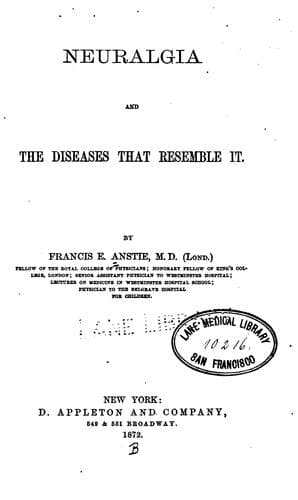
Neuralgia and the diseases that resemble itAnstie, Francis Edmund
Science
Neuralgia and the diseases that resemble it
Anstie, Francis Edmund
Neuralgia
nor do I believe that the common opinion could ever have arisen had it
not been for the rage that exists for connecting every disease with a
special diathesis which the profession flatters itself that it
understands. Few persons have taken more pains than myself to ascertain
the frequency with which neuralgic patients show a history of previous
rheumatism, whether in the so-called "fibrous," or in the synovial
form; but it is remarkable how seldom I have found this to be the
case--a result which surprised me, because it happened that I, a
neuralgic subject, had suffered in youth from regular acute rheumatism,
and had fancied that I should discover a close connection between
rheumatism and neuralgia. Eulenburg states that neuralgia caused by cold
more frequently attacks the sciatic nerve than any other, and thinks
that the tendency to sciatica is characteristic of the relations of
rheumatism to sensory nerves. For my own part, I see no reason to call
in the rheumatic diathesis as a _deus ex machina_ to explain the
frequency with which sciatica follows comparatively trifling peripheral
impressions like that of cold. The true reason I believe to be, that
what would have been a slight and trivial neuralgia elsewhere, becomes a
serious affection in the instance of the sciatic nerve, by reason of the
strong muscular pressure end dragging which are always going on in the
thigh in locomotion. I shall return to this subject when speaking of
Treatment.
As regards the relations, of gout to neuralgia, I can hardly express my
own view better than by quoting the words of Eulenburg:[17] "Much more
doubtful is the influence of gout, which in rare cases, perhaps,
produces neuralgia directly, by means of neuritis, or by the deposit of
tophus-like calcareous concretions in the nerve-trunks. Gout has been
reckoned as a great influence among the causes of superficial neuralgias
(sciatica), and also of visceral neuralgia (angina pectoris, etc.,) but
this influence is more probably only an indirect one, operating through
circulation changes which are often produced by chronic liver-diseases
or by diseases of the heart and vessels, (_e. g._ Valvular diseases and
narrowing of the coronary arteries in angina)." To which I will add this
argument against any close connection of gout with neuralgia, that it is
exceedingly seldom that colchicum effects any decided good, a fact which
is as unlike the relations of colchicum to true gout as any thing could
be. For, whatever may be thought of the advantages or disadvantages, on
the whole, of employing colchicum against gout, at least no one with any
experience will deny that in the immense majority of cases of true gouty
pain, it gives rapid relief to the acute suffering. I doubt if it
ever[18] acts in that way in real neuralgia, though I have occasionally
seen it apparently useful in a more limited way, as will be said
hereafter.
Public-domain text, read in full here on John Shaqi.
Reviews
Reviews
No reviews yet
Be the first to share your thoughts on this work.
Elsewhere in the archive
Join the Discussion
Join the discussion
Sign in to leave a comment or review.
Sign InorCreate an account