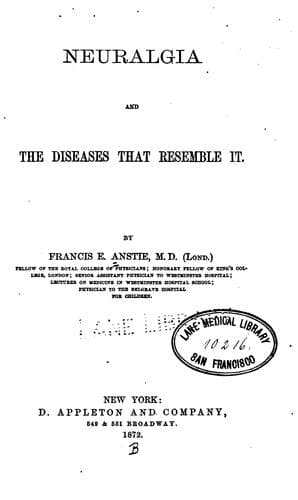
Neuralgia and the diseases that resemble itAnstie, Francis Edmund
Science
Neuralgia and the diseases that resemble it
Anstie, Francis Edmund
Neuralgia
Very much the most important of these facts is the history of a
remarkable case recorded by Romberg. ["Diseases of Nervous System," Syd.
Soc. Trans., vol. i.] The patient, a man sixty-five years old at the
time of his death, had suffered for several years from the most violent
and intractable epileptiform trigeminal neuralgia, complicated with
interesting trophic changes of the tissues. Post-mortem examination
showed that the pressure of an internal carotid aneurism had almost
destroyed the Gasserian ganglion of the painful nerve, that the trunk
and posterior root of the nerve were in a state of advanced atrophic
softening, and the atrophic process had extended in less degree to the
nerve of the opposite side. Now, the value of this case is by no means
restricted to the fact that it records the existence of a particular
anatomical change in one example of neuralgia. Its most striking
teaching is the fact that the acutest agonies of neuralgia can be felt
in a nerve, the central end of which is reduced to such a pitch of
degeneration that conduction between centre and periphery must very
shortly have entirely ceased had the patient lived. And hardly less
important is its illustration of the fact that permanent injury to the
ganglion of the posterior root of a spinal nerve impairs the vitality of
the posterior root itself--a fact which has been independently made out
by the physiological researches of Bernard and of Augustus Waller.
On the other hand, if we examine the tolerably numerous histories of
cases in which the painful nerves have been examined at the apparent
site of pain, we discover nothing to lead us to connect neuralgia
definitely with any one sort of change. Assuredly, for example, local
neuritis is by no means universally, it is probably even not commonly,
present in the early stages of neuralgia; it has also been repeatedly
detected in nerves that had been wholly free from neuralgia; and, on the
other hand, it has been entirely absent in nerves that have been the
seat of the severest pains. Moreover, many facts which have been put
down without reflection, as showing a local peripheral cause for
neuralgia, are at least open to another and, as I believe, truer
explanation; as (_e. g._) in the following remarks of Eulenburg on
mechanical irritations of nerves as causes of neuralgia: "Diseases of
bones are extraordinarily frequently the cause of neuralgias in
consequence of compression or secondary disease, which affects the
branches of nerves passing through canals, foramina, fissures, or over
processes of bone. The appearances which the opportunities of resections
of the trigeminus for facial neuralgia have permitted to be discovered,
have given us valuable information in that direction. Flattening and
atrophy of nerves from periostitis, or from concentric hypertrophy in
narrowed bony canals, have frequently been discovered. The neurilemma at
the narrowed parts was often seen reddened, ecchymosed, infiltrated with
Public-domain text, read in full here on John Shaqi.
Reviews
Reviews
No reviews yet
Be the first to share your thoughts on this work.
Elsewhere in the archive
Join the Discussion
Join the discussion
Sign in to leave a comment or review.
Sign InorCreate an account