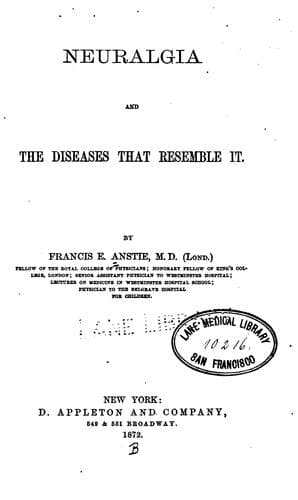
Neuralgia and the diseases that resemble itAnstie, Francis Edmund
Science
Neuralgia and the diseases that resemble it
Anstie, Francis Edmund
Neuralgia
The reader does not need to be told the familiar story of the
degenerative changes in the vessels which, commencing usually some time
during the fifth decenniad, by degrees convert the elastic arterial
coats, and the almost membranous walls of the capillaries, into more or
less rigid tubes; nor does he need to be informed that the tendency of
these changes, as they operate in the great motor and intellectual
centres, is notoriously to produce innutrition of the tissues that
depend for their blood supply on the affected vessels, whence cerebral
softening so commonly results. That analogous changes take place in the
vessels supplying the spinal centres is certain; but it is a remarkable
fact that these do not very commonly produce motor paralysis. What they
do produce is rather a slow enfeeblement both of (spinal) sensation and
motion, but where the process of decay has been prematurely forced, or
the inheritance of neurotic weakness is very marked, the process of
sensorial decay (the decline, that is, of true sensorial function) is
apt to be mingled with pain. That this pain should be localized, often
in a single nerve, is no more surprising than the fact that the
degenerative process itself should vary so greatly in the degree of its
development at one point from that which it shows at others. I have
already insisted (_vide_ Chapter I.) on the marked correspondence
between the period of life in which degenerative changes commence and
progress (the last third, roughly speaking, of a fairly long life), and
that in which the most severe, intractable, and progressively increasing
neuralgias are developed. I must here notice a singular statement of
Eulenburg's, that neuralgia never attacks people who are over seventy.
That statement shows that persons of a greater age than seventy are rare
in this world, and that no such patient happened to come under
Eulenburg's notice; for I have (by mere chance, doubtless) seen several
instances of first attacks occurring after seventy; and almost the worst
case of epileptiform tic I ever saw began when the patient was eighty;
she was a member of a highly neurotic family whose medical genealogy is
given at a previous page. In general terms, it may be said that every
additional year of life after fifty increases the probability that a
neuralgia, should such arise, will be severe and rebellious to
treatment; and in the very aged the cure of such affections is probably
impossible.
8. This seems the proper place to introduce such facts as have been
observed, and they are very few, that directly illustrate the material
changes occurring in neuralgia.
Public-domain text, read in full here on John Shaqi.
Reviews
Reviews
No reviews yet
Be the first to share your thoughts on this work.
Elsewhere in the archive
Join the Discussion
Join the discussion
Sign in to leave a comment or review.
Sign InorCreate an account