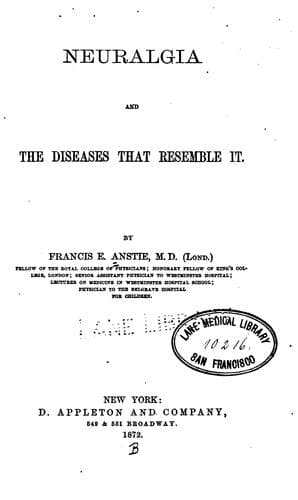
Neuralgia and the diseases that resemble itAnstie, Francis Edmund
Science
Neuralgia and the diseases that resemble it
Anstie, Francis Edmund
Neuralgia
Now, in interpreting the above phenomena, as I do, upon the theory of
one essentially uniform nutritive change affecting the fifth nerve
within the medulla oblongata, I shall be met with the following
objections: First, there is the common and superficial difficulty that
pain and paralysis of sensation must be opposite states, and that it is
impossible to refer them both to one and the same pathological process.
I have already in many places given instances how constantly pain and
sensory paralysis interchange in a manner which is totally
incomprehensible except upon the supposition that their physiological
basis is essentially the same; but the most satisfactory evidence,
perhaps, that could possibly be produced on this point is to be found in
the perusal of a group of cases observed by Hippel,[20] and entitled by
him "Anæsthesia of the Trigeminus," the loss of sensation being the most
remarkable feature. The cases are so deeply interesting that I would
gladly transfer them bodily to these pages, but must abstain from want
of space. Suffice it to say here, that, in the first place, the
anæsthesia was accompanied, in every one of these cases, by a most
distinct and typical neuralgia; and, secondly, that trophic changes
occurred which most interestingly (though not with absolute
completeness) reproduced the phenomena observed after complete section
of the trigeminus at the Gasserian ganglion.
The second objection sure to be raised to the theory of a simple
spreading of a nutritive central change, as the cause of all the
phenomena in such a case as the above, is this: It will be asked how the
process extended itself to the motor root, which, in the case of the
fifth nerve, is removed by a somewhat formidable anatomical distance
from the sensory root. I am, of course, well aware of the latter fact,
and it is an additional reason for selecting neuralgia of the fifth, as
an extra difficult test of the value of my theory. A few words must be
premised, reminding the reader of the physiological anatomy of the
nerve.
The trigeminus is in all its characters a spinal nerve; but it has
sundry peculiarities both of structure and of connections with other
nerves. Its posterior or sensory root is enormous, and, as Schroder van
der Kolk showed, takes a direction from behind downward and forward,
which is intended to facilitate its numerous and important connections
with the nuclei of other nerves: of these the most notable are its
connections with the vagus, facial, glosso-pharyngeal, and hypo-glossal
nuclei. The motor root, much smaller than the sensory, was shown by
Lockhart Clarke to be traceable as low as the inferior border of the
olivary body, as a column of cells which occupies a situation
corresponding to that of the anterior course of the spinal gray matter.
Public-domain text, read in full here on John Shaqi.
Reviews
Reviews
No reviews yet
Be the first to share your thoughts on this work.
Elsewhere in the archive
Join the Discussion
Join the discussion
Sign in to leave a comment or review.
Sign InorCreate an account