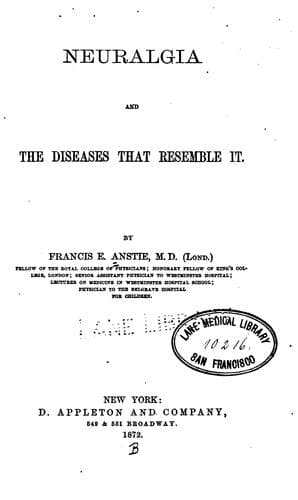
Neuralgia and the diseases that resemble itAnstie, Francis Edmund
Science
Neuralgia and the diseases that resemble it
Anstie, Francis Edmund
Neuralgia
As this column passes onward in the medulla oblongata, on a level with
the glosso-pharyngeal nerve, it forms a group of cells of large size.
Besides numerous other connections which it forms, Clarke describes the
motor root as sending processes forward, like tapering brushes or tails
of fibres, in connection with more scattered cells lying in their
course, which may be frequently seen to communicate with the transverse
bundles which traverse the "gray tubercle" and the sensory roots of the
fifth contained therein. In this way the sensory root, though seemingly
much separated from, is really in very direct connection with, the motor
root.
Now, proofs, which must be considered almost positive, have recently
been adduced to show that the nerve-fibres concerned in those peculiar
alterations in the tissues supplied by the ophthalmic division of the
fifth, which occur in section of the trigeminus, come entirely from the
motor root of the fifth, and form a very small band in the inner or
medial margin of the ophthalmic trunk. The observation of Meissner[21]
goes to show that it is possible (by good luck) to divide the trunk in
such a partial manner as to cut only the inner fibres, and thereby
produce the trophic eye-changes without any anæsthesia, or only the
sensory fibres, and thereby induce anæsthesia without any trophic
changes; and it must be owned that this really affords the only
reasonable explanation of the discrepancy between the experimental
results obtained by Magendie and Bernard; and also the facts of such
cases as those related by Mr. Hutchinson,[22] who in two instances found
that a completely anæsthetic eye recovered perfectly well from the wound
made in a surgical operation. The nature of the nervous influence
(whether ordinary vaso-motor only, or a special trophic function) has
been greatly disputed. Dr. Wegner,[23] from observing the remarkable
group of glaucomatous cases under Horner (of which one has been
related), made experiments, from which he concluded that the
augmentation of intra-ocular pressure in glaucoma was a phenomenon
dependent upon the sympathetic, which was irritated by reflection from
the trigeminus. But the researches of Hippel and Grunhagen, especially
their latest,[24] give a different explanation, excluding the
sympathetic; they found that irritation of the medulla oblongata, in the
neighborhood of the trigeminus root, produced a lasting and very
pronounced augmentation of intra-ocular blood-pressure, an effect which,
they remark, could not depend on irritation of the vaso-motor centre,
since that must produce contraction of the vessels and lowering of the
blood-pressure. They conclude that "the trigeminus contains specific
fibres which possess the property of actively dilating the blood-vessels
of the eye;" and in reference to the secretion of the fluid humors of
the eye, they conclude also that "the trigeminus also plays the part of
an (active) nerve of secretion."
Public-domain text, read in full here on John Shaqi.
Reviews
Reviews
No reviews yet
Be the first to share your thoughts on this work.
Elsewhere in the archive
Join the Discussion
Join the discussion
Sign in to leave a comment or review.
Sign InorCreate an account