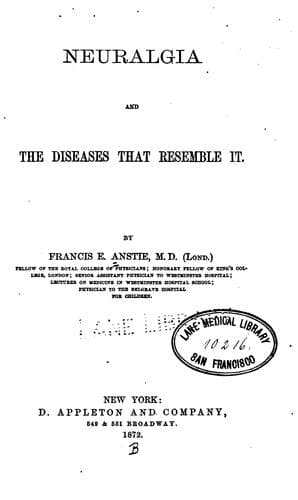
Neuralgia and the diseases that resemble itAnstie, Francis Edmund
Science
Neuralgia and the diseases that resemble it
Anstie, Francis Edmund
Neuralgia
It seems to me that, without enlarging further on this almost endless
topic, I should be justified in assuming that I had shown the very high
probability that the common starting-point both of the neuralgia and of
its vaso-motor secretory, and trophic complications, was in the sensory
root of the trigeminus. But the argument is greatly strengthened when we
consider the fact that loss of peripheral common, and also tactile
sensation, to a greater or less degree, is constantly observed to occur
simultaneously with the pain and with the other complications. When we
observe a patient suffering from racking supra-orbital and ocular
neuralgia, and discover that at the very same period the skin round the
eye is markedly insensitive to impressions, except in the _points
douloureux_, what can we rationally suppose, except that both pain and
insensibility are the result of one and the same influence, which
radiates from the sensory centre?
Nor are we likely to reach a different conclusion, if we test the matter
by the consideration of a rarer, but still sufficiently common kind of
case, such as I have described in Chapter I., in which a very strong
peripheral influence (traumatic) produces neuralgia, accompanied by
vaso-motor and secretory phenomena, and by anæsthesia, but not in the
district of the painful nerve, but in the territory of a quite different
nerve. How can we doubt, in the case, _e. g._, of a trigeminal neuralgia
thus complicated, the exciting cause of which was a wound of the ulnar
nerve, that the morbid influence, traveling inward from the lesion,
would have passed without any special consequences (as happens in
thousands of such nerve-wounds), had it not, in its passage along the
medulla, encountered a _locus minoris resistentiæ_ in the roots of the
trigeminus? It seems impossible to account for the phenomena on any
other theory. [Eulenburg says, in reference to my reported cases of the
kind: "_Solche Falle begunstigen in hohem Grade die Annahme
pradisponirender Momente, die in der ursprunglich schwacheren
Organisation einzelner Abschnitte des centralen Nerven-apparates
beruhen._" _Op. cit._, p. 56.]
It is necessary, in the next place, to consider a very important
question, how far irritation can pass over from one nerve to another,
without reflection through a spinal centre, solely in virtue of a
connection through the medium of a nervous plexus. The case which
apparently presents such phenomena in the most unmistakable way is that
of _angina pectoris_.
The site to which the essential heart-pain is referred in this disease
is probably the cardiac, or this and the aortic plexus; in a
comparatively small number of cases the pain does not extend farther.
But much more frequently it spreads in various directions, and we have
to account for its presence (_a_) in intercostal nerves, (_b_) cervical
nerves, (_c_) nerves springing from the brachial plexus.
Public-domain text, read in full here on John Shaqi.
Reviews
Reviews
No reviews yet
Be the first to share your thoughts on this work.
Elsewhere in the archive
Join the Discussion
Join the discussion
Sign in to leave a comment or review.
Sign InorCreate an account