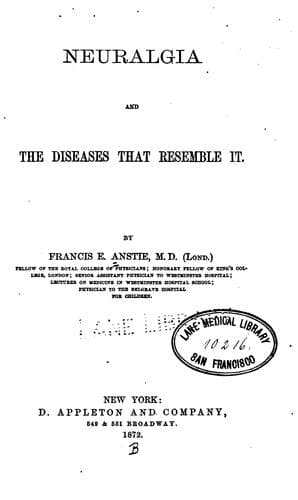
Neuralgia and the diseases that resemble itAnstie, Francis Edmund
Science
Neuralgia and the diseases that resemble it
Anstie, Francis Edmund
Neuralgia
decided but still tolerably strong acquiescence is given to Mr. Lister's
criticisms of this theory. Personally, I must express very strongly the
distrust (which is probably felt by many others) of doctrines which
assert an exact opposition between the functions of any two nerves, on
the basis of an observation that the same apparent effects may be
produced by section of the one and galvanization of the other; both
processes seem far too pathological, and too remote from the conditions
of ordinary vitality, to admit of any such absolute deductions from
their results.
In the present state of our information I am inclined to explain all the
congestive complications of trigeminal neuralgia on the basis of
vaso-motor paralysis. And I further believe that the cause of that
paralysis is a direct extension of the original morbid process from the
sensory root to the motor, affecting the origin of fibres in the latter,
which are destined to govern the calibre as ocular and facial vessels.
These fibres I suppose it is that Meissner succeeded in dividing when he
partially cut the trigeminus, and got nutritive and vascular changes
without anæsthesia.
There must be more than this, however, to account for the whole of the
trophic phenomena; for there is a great body of evidence to show that
mere vaso-motor paralysis does not produce any phenomena of such an
actively morbid kind as those we are endeavoring to explain. The
phenomena on the side of secretion might indeed be possibly explained by
vaso-motor paralysis. [It must be remembered that I am speaking of such
augmented secretion as is seen in neuralgia. I agree with Prof.
Rutherford (Lectures on Experimental Physiology, Lancet, April 29, 1871)
that it is difficult thus to explain the effects of galvanization of the
chorda tympani on the submaxillary gland.] Consisting as they do (a), in
the great majority of cases, of a mere outpour of what seems little more
than the aqueous part of the secretion, and (b) in a few cases of
arrested secretion, a phenomenon otherwise by no means unfamiliar as the
result of sudden, passive engorgement of glands. But the mere cessation
of vaso-motion will not account for such facts as the rapid and
simultaneous development of erysipelatous inflammation, of corneal
clouding and ulceration, of iritis and glaucoma, of nutrition-changes in
hair and mucous membrane. I must, for the present, be content to believe
it probable that there is a special set of efferent fibres in the
trigeminus, emanating from the motor-root, whose office it is in some
unknown way to preside over the equilibrium of molecular forces in the
tissues to which the nerve is distributed; trophic nerves, in fact,
though not active dilators of blood-vessels.
Public-domain text, read in full here on John Shaqi.
Reviews
Reviews
No reviews yet
Be the first to share your thoughts on this work.
Elsewhere in the archive
Join the Discussion
Join the discussion
Sign in to leave a comment or review.
Sign InorCreate an account