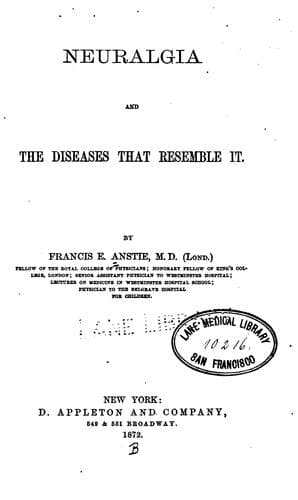
Neuralgia and the diseases that resemble itAnstie, Francis Edmund
Science
Neuralgia and the diseases that resemble it
Anstie, Francis Edmund
Neuralgia
In truth, I suspect that, whatever part the plexuses, with their
reenforcing ganglionic cells, may play during physiological life, they
are not often the channels of mutual pathological reaction of one kind
of nerve with another. It would be possible to argue this even more
strongly in the case of trigeminal neuralgias; but I must not
unnecessarily expand this already too lengthy discussion.
From the varied considerations which have now been adduced, the reader,
unless I altogether miscalculate the value of the facts, will probably
have arrived at the following conclusions: (1) That the assumption of a
positive material centric change as the essential morbid event in
neuralgia is almost forced upon us; (2) that, whereas the morbid
process, if centric, is _a priori_ infinitely more likely to be seated
in the posterior root of the painful nerve, or the gray matter
immediately connected with it, than anywhere else; so, again, the
assumption of this locality will explain, as no other theory could
explain, the singular variety of complications (all of them nearly
always unilateral, and on the same side as the pain) which are apt to
group themselves around a neuralgia; and some of which are very seldom
absent in neuralgia of any considerable severity. To this we may
certainly add that it is extremely probable that the vast majority of
neuralgic patients inherit the tendency to this localized centric
change; in support of this we may finally mention two considerations
derived from the sex and the ages most favorable to neuralgia. Eulenburg
saw a hundred and six cases of neuralgia of all kinds, of which
seventy-six were in women and only thirty in men; my own experience is
very similar; namely, sixty-eight women and thirty-two men out of a
hundred hospital and private patients. The strong connection between the
hysteric and the neuralgic temperament in women, and the great
preponderance of women among neuralgics, strengthen in no small degree
the probability of inherent tendencies to unstable equilibrium as a very
common predisposing factor in neuralgia. And, on the subject of age, I
need only recall what I have said so strongly about the coincidence of
neuralgia with particular epochs in life, as affording evidence of the
most powerful kind that neuralgics are, save in exceptional instances,
persons with congenitally weak spots in the nervous centres, which break
down into degeneration, temporary or permanent, under the strains
imposed by one or other of the physiological crises of the organism, or
the special physical or psychical circumstances which surround the
patient's life.
Having thus decidedly expressed my belief in the essential material
participation of the nerve-centre in neuralgia, it remains for me to
discuss two points: first, as to the character of the material change in
the nerve-root, and next, as to the extent to which mere peripheral
influence, without special inherited tendencies, may suffice to set this
process going.
Public-domain text, read in full here on John Shaqi.
Reviews
Reviews
No reviews yet
Be the first to share your thoughts on this work.
Elsewhere in the archive
Join the Discussion
Join the discussion
Sign in to leave a comment or review.
Sign InorCreate an account