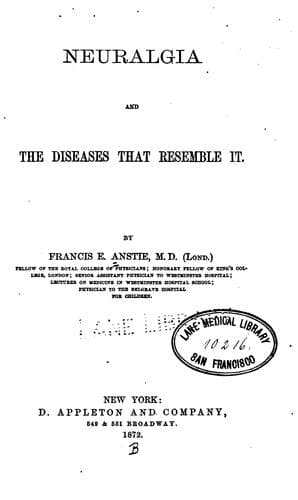
Neuralgia and the diseases that resemble itAnstie, Francis Edmund
Science
Neuralgia and the diseases that resemble it
Anstie, Francis Edmund
Neuralgia
The morbid change in the nerve-centre is probably, in the vast majority
of cases, an interstitial atrophy, tending either to recovery, or to the
gradual establishment of gray degeneration, or yellow atrophy, of
considerable portions of the whole of the posterior root, and the
commencement of the sensory trunk as far as the ganglion.
It is probable, however, that in a certain number of cases, the atrophic
stage may be preceded by a process of genuine inflammation, and that
this inflammation is centripetally produced in consequence of
inflammations of peripheral portions of the nerve. The considerations
which make this probable are chiefly derived from the analysis of cases
in which a more or less chronic, but severe, visceral disorder has been
followed by so-called reflex paralysis, but in which neuralgic
phenomena, have been conspicuous. In reference to this subject I
recommend to the reader's attention the very interesting paper on
"Reflex Paralyses" by Prof. Leyden, of Konigsberg.[28] He is immediately
commenting upon a case in which dysenteric affection of the bowel were
followed by the symptoms of myelitis, attended with febrile
exacerbations, and also with severe pains in the region of the sacrum,
in the course of the dorsal intercostal nerves of the right side, and in
the knees, and semi-paralytic weakness of the lower extremities, and
with pains between the shoulder-blades and the left arm. Leyden
discusses the doctrine of reflex paralyses in general, starting from
the cases of urinary paraplegia brought forward by Stanley, in 1835, and
tracing the growth of opinion through the phases represented by Graves,
Henoch, and Romberg, by Valentine and Hasse, then by Pfuger, and other
professors of the inhibitory doctrine; by Brown-Sequard (in his
well-known, and now very generally discredited, theory of spasm of the
vessels in the nervous centres), by Jaccoud in the "Erschopfung"
(exhaustion) theory, down to the more careful and reliable researches of
Levisson on the temporary reflected paralyses induced by experimental
squeezing of the kidney or uterus of animals; and then gives the history
of the more recent doctrine of a positive material change in the cord
centripetally introduced. Gull[29] (1856) may be said to have
inaugurated the new doctrine of a morbid process transmitted along the
pelvic nerves to the cord, and causing material changes there.
Remak,[30] on the other hand, suggested a material change operating in
the opposite direction; _a neuritis descendens_, starting in the very
nerves (within the pelvis) which showed the paralysis in the
extremities. The symptoms are supposed by him to be distinctive,
inasmuch as there is both violent pain in the nerves of the soles of the
feet, and also tenderness of the same. On the other hand, Remak said
that myelitis, with neuritis, might be the origin of paraplegia and
simultaneous palsy of bladder and rectum. The theory of neuritis
Public-domain text, read in full here on John Shaqi.
Reviews
Reviews
No reviews yet
Be the first to share your thoughts on this work.
Elsewhere in the archive
Join the Discussion
Join the discussion
Sign in to leave a comment or review.
Sign InorCreate an account