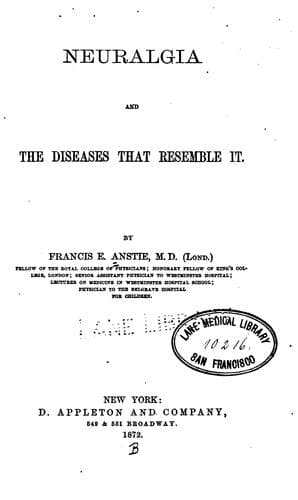
Neuralgia and the diseases that resemble itAnstie, Francis Edmund
Science
Neuralgia and the diseases that resemble it
Anstie, Francis Edmund
Neuralgia
to suppose that severe pain would be an immediate symptom. But, thirdly,
a far more important objection to the theory of an origin in localized
centripetal myelitis, the result of a neuritis migrans, is the rarity of
motor paralysis as an early symptom, instead of which we ought to find a
very distinct history of decided paralysis (much more decided than those
secondary paralyses which actually do occur in some neuralgias) of the
muscles supplied by the anterior roots of the painful nerve, in every
case in which such a peripheral origin could be assumed. Again, the
totally feverless commencement of neuralgias, a character which is
maintained throughout the progress of the milder cases, is entirely
opposed to the idea of a direct connection between myelitis and
neuralgia. The superficial appearance of pyrexia is sometimes given by a
local vaso-motor paralysis, which makes the neuralgic part, after a long
bout of pain, hot and red; but of general pyrexia there is nothing.
Taking every thing into consideration, one is inclined to say that there
is a probability that in a very limited number of cases peripheral
irritation does cause actual limited myelitis, which escapes recognition
at the time, but which issues in an atrophy, the subjective expression
of which is actual neuralgic pain. We may well ask ourselves, also,
whether there is not some likelihood that a peripheral irritation, which
stops short of producing an actual neuritis migrans capable of
centripetally exciting a myelitis, may not, by a lower degree of
centripetal irritation, give a bias toward certain forms of
non-inflammatory atrophy in cells of posterior nerve-roots which are
congenitally of weak organization. I am inclined to believe strongly
that this does occur. For example, I should explain thus the majority of
the peripheral cases of ciliary neuralgia, migraine, etc., that we meet
with in poor young needle-women, especially the hypermetropic, who, at
an age when they can ill afford the strain, work so constantly and
strenuously at an occupation which fearfully taxes the eye.
Public-domain text, read in full here on John Shaqi.
Reviews
Reviews
No reviews yet
Be the first to share your thoughts on this work.
Elsewhere in the archive
Join the Discussion
Join the discussion
Sign in to leave a comment or review.
Sign InorCreate an account