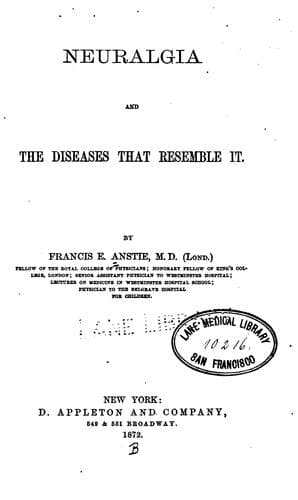
Neuralgia and the diseases that resemble itAnstie, Francis Edmund
Science
Neuralgia and the diseases that resemble it
Anstie, Francis Edmund
Neuralgia
descendens was supported by Kussmaul,[31] in the record of a case where
disease of the bladder was complicated with pelvic inflammation,
atheromatous degeneration of the arteries, and consequent fatty
degeneration of the sciatic nerves, causing direct paraplegia. We return
to the centripetal theory of urinary paralysis with Leyden's own cases,
published in 1865; of three patients with urinary paraplegia, two died,
and the existence of a secondary (centripetal) myelitis seems to have
been established, and by all analogy it must have existed in the third
case, which recovered. The only puzzle and doubt that ensued was caused
by the fact that there was an absence of neuritis in the different
nerves themselves; though it seemed plain that the starting point of the
myelitis was at the entrance of these nerves into the cord. This mystery
seemed to be cleared up by the important experiments of Tiesler, ("Ueber
Neuritis" Konigsberg, 1860) a pupil of Leyden's. This observer excited
local traumatic inflammation in the sciatic nerve of rabbits and dogs;
the rabbit became paraplegic and died three days afterward. At the site
of the artificial irritation there was a localized formation of pus, and
there was a second similar formation within the vertebral canal at the
point where the posterior roots of the sciatic enter the cord; but
there was no neuritis of the intervening portion of the nerve.
Upon this and similar evidence is based the modern doctrine of a
neuritis migrans, with centripetal tendencies, upon which it is supposed
that a very large proportion, at least, of the urinary, dysenteric, and
uterine paraplegias, miscalled "reflex," depend; and it is clear that
the application of the word "reflex" in such a case is a grave abuse,
tending to produce such confusion of thought and error in practice. In
relation to the subject of our own inquiry--neuralgia--it is obviously
of the highest consequence to investigate the question whether
peripheral irritations, analogous to those which produce urinary
paraplegia, are at all frequently the cause of the changes in the
posterior roots which produce true neuralgia; for of course an
inflammation may be the beginning of an atrophy which may presently
exhibit no distinction whatever from one of which the origin was
altogether non-inflammatory. I think that there is strong reason for
thinking that this is not at all frequently the case. In the first
place, all the evidence that exists respecting these centripetal
inflammations of the cord is opposed to the idea that, save in the
rarest instances, the inflammatory process limits itself to one small
segment of the cord. Secondly, the description of the pains that have
usually accompanied such inflammations of the cord is considerably
different from the strictly localized, frankly intermittent character of
a true neuralgia; in fact, all we know of the history of myelitis
(except when complicated with a large amount of meningitis) forbids us
Public-domain text, read in full here on John Shaqi.
Reviews
Reviews
No reviews yet
Be the first to share your thoughts on this work.
Elsewhere in the archive
Join the Discussion
Join the discussion
Sign in to leave a comment or review.
Sign InorCreate an account