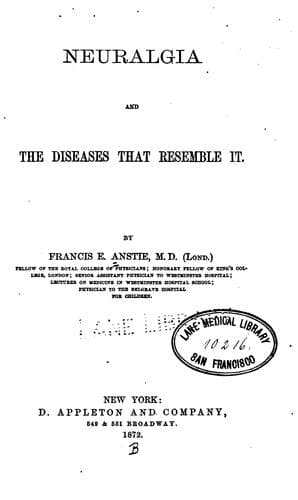
Neuralgia and the diseases that resemble itAnstie, Francis Edmund
Science
Neuralgia and the diseases that resemble it
Anstie, Francis Edmund
Neuralgia
(1) The first and most essential characteristic of a true neuralgia is,
that the pain is invariably either frankly intermittent, or at least
fluctuates greatly in severity, without any sufficient and recognizable
cause for these changes.
(2) The severity of the pain is altogether out of proportion to the
general constitutional disturbance.
(3) True neuralgic pain is limited with more or less distinctness to a
branch or branches of particular nerves; in the immense majority of
cases it is unilateral, but when bilateral it is nearly always
symmetrical as to the main nerve affected, though a larger number of
peripheral branches may be more painful on one side than on the other.
(4) The pains are invariably aggravated by fatigue or other depressing
physical or psychical agencies.
The above are characteristics which every genuine neuralgia possesses,
even in its earliest stages; if they be not present, we must at once
refer the diagnosis to one or other of the affections described in Part
II. of this work.
Supposing the above symptoms to be present, we expect to find--
(5) In by far the largest number of instances that the patient has
either previously been neuralgic, or liable to other neuroses, or that
he comes of a family in which the neurotic disposition is well marked.
Failing this, we are strongly to doubt the neuralgic character of the
malady, unless we detect that there has been--
(6) A poisoning of the blood by malaria (but this very rarely causes
neuralgia, save in the congenitally predisposed); or--
(7) A powerfully operating or very long-continued peripheral irritation
centripetally directed upon the sensory nucleus of the painful nerve;
which irritation may be (_a_) "functional," as where the eye has been
persistently and severely over-strained and trigeminal pain results, or
a sudden severe shock has been received; or, (_b_) coarsely material, as
where inflammation, ulceration, etc., of surrounding tissues involve the
periphery of the painful nerves in a perpetually morbid action, or
chronic but profoundly depressing psychical influences; or--
(8) A constitutional syphilis. In this case there will either be marked
syphilitic local affection of the trunk of a nerve, or if, as is more
common, the syphilitic change is in the nerve-centre, there will most
likely be other syphilitic centric mischiefs, leading to scattered motor
or vaso-motor paralyses, characteristic modifications of special
sense-functions, etc.
If the neuralgia be of some standing and a certain degree of severity,
there will inevitably be found--
(9) Some of the fixed tender points of Valleix, in such situations as
have been described in Chapter I.; and--
Public-domain text, read in full here on John Shaqi.
Reviews
Reviews
No reviews yet
Be the first to share your thoughts on this work.
Elsewhere in the archive
Join the Discussion
Join the discussion
Sign in to leave a comment or review.
Sign InorCreate an account