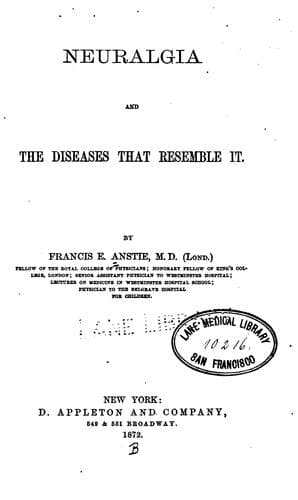
Neuralgia and the diseases that resemble itAnstie, Francis Edmund
Science
Neuralgia and the diseases that resemble it
Anstie, Francis Edmund
Neuralgia
(10) Secondary affections (_a_) of secreting glands, or (_b_) vaso-motor
nerves; or (_c_) of nutrition of tissues; or secondary localized
paralyses of muscles, or localized anæsthesia of a somewhat decided
though not complete kind, as described in Chapter II.; any one or any
number of these various complications may be present.
I must insist that the above picture includes only the essentials for a
diagnosis of neuralgia; if the painful affection will not answer to the
conditions therein included, we have no right to call it a neuralgia--it
belongs, for every practical purpose, to some other category of disease.
Let me add one more essential characteristic, which is, that the pain
begins and assumes its characteristic type before any other of the
phenomena appear, with the single and partial exception of anæsthesia.
There are some special modes of diagnosis of the varieties of
neuralgia, developed of late years, that require notice here; they are
chiefly the result of the researches of Moriz Benedikt.
As regards the quality of the pain, Benedikt says that the curve of
intensity has an intimate relation to the _locus in quo_ of the
neuralgia (_i. e._, whether in the periphery, trunk, or roots). An
inflammatory irritation set up at the periphery of a nerve (by a
joint-inflammation, for instance) produces a continuous pain; the same
kind of irritation, attacking a nerve-trunk (_e. g._, in the bony
canals), produces a paroxysmal pain; an inflammation spreading from the
vertebræ to the nerve-roots or the cord-centres produces momentary
lancinating pains. The latter characteristic he supposes to be
especially characteristic of the centrally-produced neuralgias; and I
may observe, as so far confirmatory of this idea, that this is
especially the character of the pains in locomotor ataxy. There are
sundry special cases to be considered, however: thus, Benedikt himself
remarks that the pain set up by the pressure of a pulsating aneurism is,
from the nature of things, lancinating from moment to moment.
Eulenburg,[32] moreover, says that Benedikt's tests of the locality of
the primary mischief only hold good under the following circumstances:
(1) When the irritability and the exhaustibility of the nerves are in a
normal condition during the neuralgia; (2) when the irritation that
calls forth the paroxysm is either identical with the original cause of
the disease, or at least operates upon the same spot. The two
conditions, however, do not concur. The irritability and exhaustibility
may be sometimes excessive in neuralgias, sometimes normal, and perhaps,
in certain cases, beneath the normal standard; by which means the form
of the curve of intensity must be considerably modified. Moreover, the
irritation that provokes an attack may from the periphery attack the
primary seat of the disease, even when this is central, on account (says
Eulenburg) of exaggerated conductivity of the nerves (his second
Public-domain text, read in full here on John Shaqi.
Reviews
Reviews
No reviews yet
Be the first to share your thoughts on this work.
Elsewhere in the archive
Join the Discussion
Join the discussion
Sign in to leave a comment or review.
Sign InorCreate an account