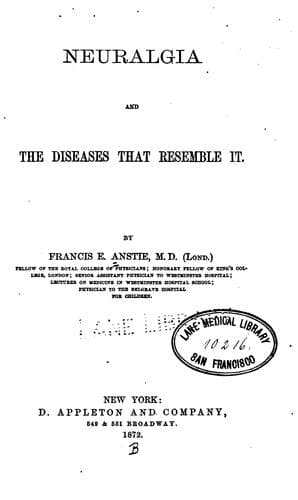
Neuralgia and the diseases that resemble itAnstie, Francis Edmund
Science
Neuralgia and the diseases that resemble it
Anstie, Francis Edmund
Neuralgia
cause[33] of "hyperæsthesia"), as is, in fact, very frequently the case.
He also thinks the distinction between paroxysmal and lancinating pains
too indefinite to serve as a sufficiently reliable basis of diagnosis,
especially considering the endless _nuances_ of the form which the pain
is apt to take. I agree with Eulenburg upon this point; and am
convinced, from my own observations, that such a distinction as that
between lancinating and paroxysmal pains is illusory, [I have taken some
pains to investigate the character of the pains, not only in neuralgia,
but in locomotor ataxy. It is true that the lancinating character
predominates, on the whole, in the latter disease; but there are great
differences in different individuals, and even in the same patient at
various times, which plainly depend on subjective influences. Compare
for instance, Dr. Headlam Greenhow's report on an ataxic patient, with a
report on the same man by Dr. Buzzard and myself. ("Trans. Clin. Soc.,"
vol. i., 1868, pp. 152-162.)] the two kinds being frequently found
alternate in the same case. The only useful distinction, in my opinion,
is Benedikt's first one: he is probably right in saying that, where such
an affection as an inflamed joint forms the source of peripheral
irritation that immediately provokes a neuralgia, the pain is apt to be
unusually continuous.
The extent to which the pain of neuralgia spreads into different termini
of the same nerve has been made the basis of distinctions as to the seat
of the original mischief. For example, it has been said that pain in the
mental branch of the third division of the trigeminus, which does not
invade the auriculo-temporal branch, can hardly depend on an irritation
operating on the trunk of the inferior dental; it must be distinctly
peripheral, or else it must act upon limited portions of the central
origin of the fifth nerve. But the fact seems rather to be that, whether
the neuralgia was excited by lesions at the periphery, in the
nerve-trunk, or in the centre, it is equally possible that either a
small or a large part of the peripheral expanse of the nerve may become
the seat of the pain: this almost necessarily follows from the entire
independence of individual fibres in nerves.
Public-domain text, read in full here on John Shaqi.
Reviews
Reviews
No reviews yet
Be the first to share your thoughts on this work.
Elsewhere in the archive
Join the Discussion
Join the discussion
Sign in to leave a comment or review.
Sign InorCreate an account