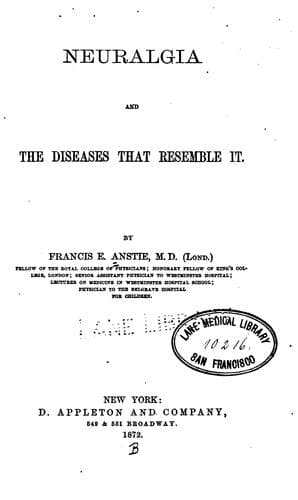
Neuralgia and the diseases that resemble itAnstie, Francis Edmund
Science
Neuralgia and the diseases that resemble it
Anstie, Francis Edmund
Neuralgia
The application of electricity as a test of the nature of a neuralgia
has been employed by Benedikt,[34] who lays down certain laws as the
result of his researches. He says that (_a_) in idiopathic peripheral
neuralgias the nerves are not sensitive to the current; (_b_) in
neuralgias dependent on neuritis or hyperæmia of the nerve-sheath there
is general electric tenderness of the nerve; (_c_) in cases where the
pain has been set up by morbid processes in tissues surrounding the
nerve, there is electric tenderness only at the site of these changes. I
may, in general terms, express concurrence in these statements; but I
must add that, as diagnostic rules they apply only to the early stages
of neuralgia; for the occurrence of secondary complications may and does
altogether change the condition of electric sensitiveness. It need
hardly be said that the above remarks on diagnosis apply for the most
part only to the superficial neuralgias, which, however, include an
immense majority of the cases of neuralgias. The diagnosis of visceral
neuralgias is, it need hardly be said, in most cases, a far more
difficult and complicated matter. In these diseases we have often little
more to guide us, in the actual symptoms, than (_a_) the intermittence
of the pain, and (_b_) the absence of commensurate constitutional
disturbance, especially the complete freedom from sense of illness in
the intervals between the pains. We shall be obliged to rely greatly on
such historical facts as the presence or absence of neurotic tendencies
in the patient and his family; the possibility of his having been
exposed to blood-poisoning (_e. g._, from malaria or chronic alcoholic
excess, or extreme over-smoking); the circumstance that he has been
habitually overworked, or greatly exposed to agitating psychical
influences; perhaps that he has been subject to a combination of several
of these morbific momenta. To say truth, the diagnosis of visceral
neuralgias must, at the best of times, be a difficult and anxious
matter, and we can hardly ever thoroughly satisfy ourselves until we
have procured some decided results from treatment; fortunately, however,
it happens tolerably often that we can do this, and sometimes in a very
striking way.
_Prognosis._--The prognosis of neuralgia varies exceedingly, according
to the form and situation of the disease, and many other considerations.
There are, of course, in the first place, certain neuralgias in which
the prospect is perfectly hopeless as to cure; such are the cases in
which the nerve is involved in a continuously growing tumor (especially
within a rigid cavity, like the skull), or a slow but persistent
ulcerative process.
Supposing, however, that the case is none of these, the very first
prognostic consideration is that of age.
Public-domain text, read in full here on John Shaqi.
Reviews
Reviews
No reviews yet
Be the first to share your thoughts on this work.
Elsewhere in the archive
Join the Discussion
Join the discussion
Sign in to leave a comment or review.
Sign InorCreate an account