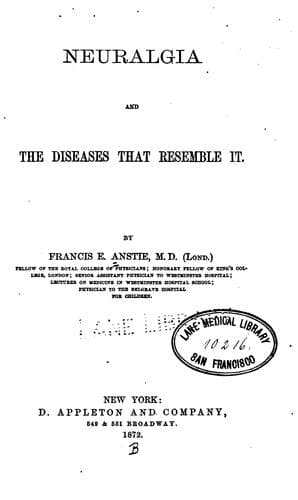
Neuralgia and the diseases that resemble itAnstie, Francis Edmund
Science
Neuralgia and the diseases that resemble it
Anstie, Francis Edmund
Neuralgia
The part which gout may play in inducing neuralgia is, as I have already
said, a far more doubtful question than the popular medical traditions
assume it to be; and treatment directed to gout as a cause is an
extremely uncertain affair. The direct relief of neuralgic pain by the
administration of colchicum, for example, is, in my experience, a very
rare occurrence, even where the gouty diathesis is unmistakably present;
and, on the other hand, the depressed vitality which gouty neuralgics
usually show in a marked degree, renders it very doubtful whether the
relief of the pain may not be too dearly purchased at the cost of the
general lowering effects of colchicum. It is probable that neuralgia
occurring in gouty subjects is more safely, and equally effectually,
treated upon general principles. At the same time it may be admitted
that, in the subordinate function of an adjuvant to the aperients which
it is sometimes advisable to give, small doses of the acetic extract of
colchicum seem to possess some value.
The question of treatment addressed to a supposed rheumatic element in
neuralgia will, of course, be differently judged according to the
respective ideas of various practitioners as to the pathological
affinities of the two diseases; and the reader already knows that I
believe these affinities to be different in kind from what is generally
believed. The utmost that I should concede is, that in a certain very
limited number of cases the peripheral factor in neuralgia is an
inflammation of the nerve-sheath, or surrounding tissues, which forms
part of a chain of phenomena of local fibrous inflammations in different
parts of the body. Iodide of potassium, in five or ten grain doses
three times a day, is the proper treatment for such cases. I have never
found alkalies do any direct good to the pain.
(_c_) The medicinal tonic variety of constitutional treatment is more
especially represented by the use of iron and arsenic in cases where
poverty of the blood seems to exist in a marked degree, and by the
administration of certain tonics--quinine, phosphorus, strychnia, and
zinc--which are supposed to exert a specially restorative influence upon
the nervous tissues.
The use of quinine as an anti-malarial agent has been already referred
to; its employment in non-malarial cases is of much more restricted
scope and benefit. Experience has taught me to agree in general with the
opinion of Valleix, that it is a very unreliable agent; the one marked
exception to this being the case of ophthalmic neuralgias. What the
reason may be I cannot in the least say, but it is a fact that quinine
does benefit these neuralgias, in cases where there is no room for
suspicion of malaria, with a frequency which is very much greater than
in the treatment of the painful affections of any other nerve in the
body. The quantity given should be about two grains three times a day.
Public-domain text, read in full here on John Shaqi.
Reviews
Reviews
No reviews yet
Be the first to share your thoughts on this work.
Elsewhere in the archive
Join the Discussion
Join the discussion
Sign in to leave a comment or review.
Sign InorCreate an account