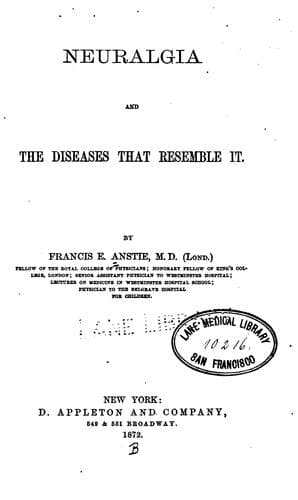
Neuralgia and the diseases that resemble itAnstie, Francis Edmund
Science
Neuralgia and the diseases that resemble it
Anstie, Francis Edmund
Neuralgia
But of the sesquichloride of iron I am inclined to say something more;
it has seemed to me that, besides its effects on the blood, it has a
marked and direct influence upon the nervous centres, which is different
from anything which one observes in the action of other preparations of
iron. It is certain that the action of sesquichloride of iron, in those
cases of chlorosis which are distinguished by profound nervous
depression, is something quite peculiar; and the effect which it
produces in the anæmic neuralgias, more especially of young women, is
equally remarkable. I cannot help alluding here to the striking effects
which large doses of the tincture, as recommended by Dr. Reynolds,
produce in acute rheumatism; the severest pain is often checked within
twenty-four hours after the commencement of this treatment. Both in this
disease and in neuralgia, I employ the old-fashioned tincture: if given
alone it should be used in large doses (thirty or forty minims three
times a day); but an excellent combination is that, already mentioned,
of ten-minim doses of this tincture with one-fortieth of a grain of
strychnia. There is something in the revivifying effects of this mixture
that is quite peculiar. I have very lately employed it in the case of a
gentleman, aged thirty-five, who was the subject of frontal neuralgia
complicated with paralysis of the internal rectus, and who was decidedly
anæmic, and greatly depressed and worried in mind by the consciousness
of his inability to overtake professional work which had accumulated
upon him. This patient improved with great rapidity, and in the course
of three weeks lost, not merely his neuralgia, but also his strabismus,
almost entirely; but he then got into a condition which, though not of
permanent importance, was sufficiently undesirable to make me mention it
here, especially as I have seen the same thing in more than one patient
besides him. It is a peculiar state of restlessness during the day and
sleeplessness at night, without any positive exaltation of reflex
excitability such as one used to see from strychnia in the days when
mischievously large doses of that drug were very commonly given, and
patients used to complain of decided twitchings and startings of the
limbs. It is clearly not a strychnia effect pure and simple, nor an iron
effect only; it is a _tertium quid_ compounded of the actions of both
drugs.
Public-domain text, read in full here on John Shaqi.
Reviews
Reviews
No reviews yet
Be the first to share your thoughts on this work.
Elsewhere in the archive
Join the Discussion
Join the discussion
Sign in to leave a comment or review.
Sign InorCreate an account