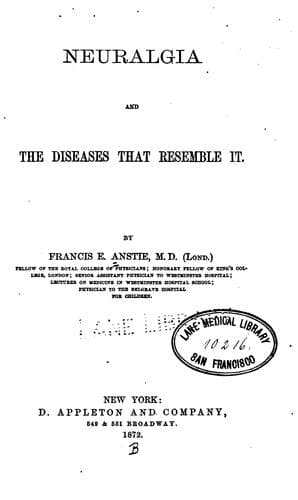
Neuralgia and the diseases that resemble itAnstie, Francis Edmund
Science
Neuralgia and the diseases that resemble it
Anstie, Francis Edmund
Neuralgia
The direct effects of arsenic in the improvement of the quality of the
blood seem to me incontestable; and its use for this purpose in anæmic
neuralgias is certainly something over and above its special neurotic
action. No one, who has employed it much in the cases of anæmic children
suffering from chorea after rheumatism, can have failed to observe its
frequently striking influence upon blood-formation even long before the
nervous ataxia is materially reduced. The misfortune is, however, that
we possess no indications by which to judge beforehand whether we may
reckon on its most favorable action in any given (non-malarious) case,
with certain special exceptions. In angina pectoris it has a most direct
effect, which is rarely altogether missed, and is sometimes surprising:
the cases in which it succeeds best are those distinguished by anæmia,
but we may well suppose, from its remarkable action upon other neuroses
of the vagus, that it is something more than an action on the
blood-making process which produces such powerful effects in allaying
the tendency to recurrence of the paroxysms. My attention was called to
its action in this disease chiefly by the remarkable case published by
Philipp;[37] this was a purely neurotic angina, but one of the severest
type, and the influence of arsenic was very striking. Since that time I
have employed it in several cases, and, after trying various forms of
administration, I conclude that nothing is better than Fowler's
solution, in doses of three minims (gradually increased, if the remedy
be well tolerated, up to eight or ten) three times a day. Unfortunately,
there are some neurotic patients who cannot bear arsenic, the
irritability of their alimentary canal is such that the drug always
provokes vomiting, or diarrhoea, or both; this was the case with one
of my patients, in whose case I had allowed myself to hope for the very
best results from arsenical treatment. But where the patient tolerates
it--and usually he tolerates it extremely well--the prolonged use of
arsenic seems really to root out the anginoid tendency, or at least to
confine it to the more trivial and manageable manifestations. I believe
that in at least three patients, I have so completely broken down a
succession of cardiac neuralgic attacks as to substitute for them a mere
remnant of a tendency to "tightness at the chest" after any severe
bodily exertion or mental emotion. It might be a question, in cases
where the stomach does not tolerate the ordinary administration of the
agent, whether it would not be worth while to try the effect of
subcutaneous injection (two to four minims of Fowler), or inhalation of
the smoke of arsenical cigarettes. But, in truth, it is not certain that
even in this case we escape the characteristic effects of the drug upon
those persons who are abnormally sensitive to it.
Public-domain text, read in full here on John Shaqi.
Reviews
Reviews
No reviews yet
Be the first to share your thoughts on this work.
Elsewhere in the archive
Join the Discussion
Join the discussion
Sign in to leave a comment or review.
Sign InorCreate an account