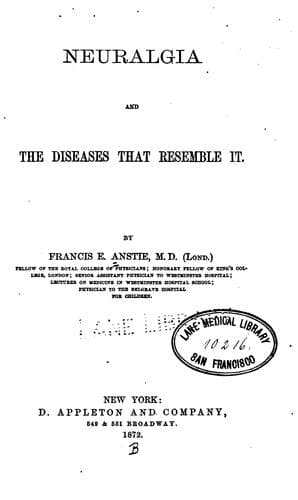
Neuralgia and the diseases that resemble itAnstie, Francis Edmund
Science
Neuralgia and the diseases that resemble it
Anstie, Francis Edmund
Neuralgia
A remarkable instance of the beneficial influence of arsenic occurred in
the case of a woman, aged forty-six, the solitary example of severe
angina in a female that I have ever seen. [It is by no means uncommon,
however, to see the milder forms of cardiac neuralgia in women; the
remarkable statistics of Forbes, quoted in Chapter I., must certainly
have been taken exclusively from cases of the severest type of the
disease.] This was a hospital patient, who had always suffered much
from hysteria, and from childhood had been liable to hemicranic
headache; she had entered on the period of "change" at the time the
attacks began, but menstruation, though irregular, still continued, and,
in fact, did not cease till four years later, long after the anginal
attacks had been subdued. The patient had been attacked for the first
time at the end of a heavy day's washing; she dropped on the ground with
the sudden agony and faintness, and thought she should "never come to
life again." The paroxysms returned five times within the next month,
though not always so severely as on the first occasion; but the poor
woman lived in a constant state of terror. On the occasion of her second
visit to me, she had a most severe attack in the waiting-room at the
hospital: being called to her I found her very nearly pulseless,
gasping, and with the kind of complexion which is so suggestive of
approaching death. She was recovered by a large dose of ether. It was a
rather uncommon feature in this case that the pain was only at and
around the lower end of the sternum, except that occasionally it shot
along the sixth intercostal space. The employment of Fowler's solution
(in doses gradually mounting to twenty-one minims daily) for six months
completely eradicated the anginal tendency; the proof that it was a real
therapeutic effect was given by the result of an attempt to leave the
medicine off at the end of eight weeks' treatment; the patient
immediately began to suffer again. When she really left off, at the end
of six months' treatment, she had had no tendency to heart-pang for more
than a month, and, besides this, looked quite another creature in her
improved vitality and vigor. Yet the menstrual troubles went on, and the
function was not finally suppressed for a long time afterward.
Public-domain text, read in full here on John Shaqi.
Reviews
Reviews
No reviews yet
Be the first to share your thoughts on this work.
Elsewhere in the archive
Join the Discussion
Join the discussion
Sign in to leave a comment or review.
Sign InorCreate an account