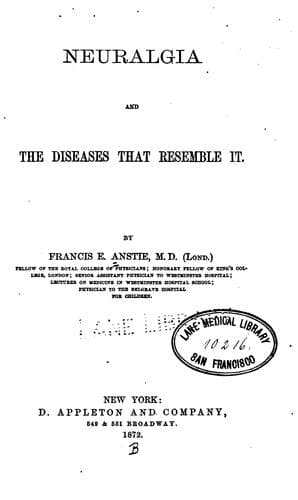
Neuralgia and the diseases that resemble itAnstie, Francis Edmund
Science
Neuralgia and the diseases that resemble it
Anstie, Francis Edmund
Neuralgia
These cases of so-called spinal irritation with general hysteric
manifestations are very commonly attended with paroxysmal pains that
approach true neuralgia in character. Nor is it to be denied that we
sometimes meet with the combination of general hysteria, spinal
tenderness in definite points (with secondary spasmodic or paralytic
phenomena always following pressure exerted on the latter), and true
neuralgia limited to one nerve. But the more typical spinal irritation
cases are merely complicated with a tendency to vague pains which are
shifting both in character and position, not with definite unilateral
neuralgia always haunting the same nerve and exhibiting more or less of
the same type. In fact, as far as one can judge in the absence of any
precise information as to the condition of the nervous centres in such
cases, it would seem likely that the ordinary cases of spinal irritation
differ from the true neuralgias chiefly in this--that the injury, or
inherited weakness of organization, or both, which is at the root of the
malady, is at once slighter in degree, and spread over a larger tract of
the nervous centres, than that which produces a true neuralgia. I
believe that Dr. Radcliffe is right in supposing it to be probable that
a blow or other injury to the back producing general spinal shock, is
the original but unsuspected cause of a large proportion of these cases.
One of the most perfect examples of spinal irritation that I have ever
seen (and which also contrasts keenly with the commoner hysteric
affections on the one hand, and the true neuralgiæ on the other) was
that of a girl whom I examined together with Dr. Walshe, Dr. Reynolds,
and Dr. Bridge. This young lady was a most intelligent person, and not
in the slightest degree inclined to the apathy and idleness so often
seen in hysterical people. She had received what was thought at the time
to be a very slight contusion in a railway collision, in which, however,
her sister, who was in the same carriage, had been severely injured. She
nursed this sister assiduously, and it was not till three or four months
later that her own health began to fail seriously; but she then became
anæmic and extremely depressed. About six months after the accident it
was quite casually discovered that there was a spot over the lowest
cervical vertebra, pressure on which gave her exquisite pain and a
sensation of extreme nausea; and the very curious observation was made
that such pressure instantaneously produced extinction of the right
pulse, the left pulse remaining unaltered. In this case it cannot be
doubted that a serious shock had been communicated to a lateral segment
of the cord involving chiefly the vaso-motor nerve fibres, in which
probably some decided material lesion had been gradually set up; and
besides this there was probably slighter damage to the spinal cord
generally, as there was great general feebleness of movement, though no
actual paralysis of the limbs.
Public-domain text, read in full here on John Shaqi.
Reviews
Reviews
No reviews yet
Be the first to share your thoughts on this work.
Elsewhere in the archive
Join the Discussion
Join the discussion
Sign in to leave a comment or review.
Sign InorCreate an account