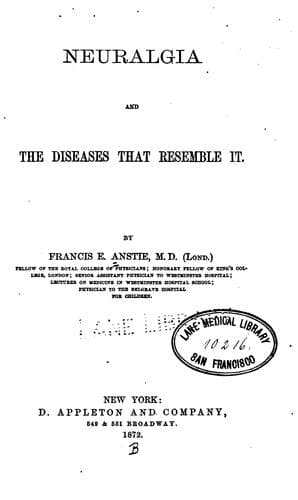
Neuralgia and the diseases that resemble itAnstie, Francis Edmund
Science
Neuralgia and the diseases that resemble it
Anstie, Francis Edmund
Neuralgia
Along with the phenomena of fixed spinal tenderness, without distinct
neuralgia of any particular nerve, we not unfrequently observe the
development of more or less decided tenderness of some of the internal
surfaces of the body. I have recently had under my care a young woman in
whom a very tender point was developed over the second cervical
vertebra, and who suffered from such persistent tenderness of the whole
posterior part of the pharynx, that I was for some time seriously
apprehensive of the existence of spinal caries and post-pharyngeal
abscess. The general character of her symptoms, however, induced me to
hope that the case was one of spinal irritation merely, and the event
proved that this was the case, for under the use of iron and small doses
of strychnia she recovered completely in about three weeks. In another
patient who came under my care about twelve months ago, there was
extraordinary sensitiveness of the gastric mucous membrane, causing
exquisite pain after she had eaten almost any thing: there was only
occasional vomiting, however, and there had never been any hæmorrhage,
so that the evidence for gastric ulcer, which I otherwise inclined to
think existed, was insufficient. I discovered that pressure on the third
or the fourth dorsal vertebra gave great pain, and produced a strong
inclination to vomit; this made it probable that the affection was
spinal, and accordingly all treatment addressed to the stomach was
abandoned. Flying blisters to the neighborhood of the painful spinal
points quickly relieved all the symptoms.
Another distressing class of symptoms, which is very commonly observed
in connection with these cases of spinal irritation, is that of abnormal
arterial pulsations: I am not sure whether even severe neuralgia
produces more distress than does this pulsation. I have repeatedly seen
abnormal pulsation of the carotids in connection with fixed
tender-points over the cervical or the upper dorsal vertebræ; and still
more commonly pulsation of the abdominal aorta in connection with
tenderness over one or two of the upper dorsal vertebræ. Spasmodic cough
and spasmodic dyspnoea frequently accompany tenderness of points in
the upper half of the spinal column; and in one instance I have seen
pressure on the lowest cervical vertebræ produce a paroxysm which looked
alarmingly like angina pectoris. A case of singularly prolonged and
obstinate spasmodic hiccough which came under my notice was
distinguished by the presence of a fixed tender spot over the third
dorsal vertebra.
Public-domain text, read in full here on John Shaqi.
Reviews
Reviews
No reviews yet
Be the first to share your thoughts on this work.
Elsewhere in the archive
Join the Discussion
Join the discussion
Sign in to leave a comment or review.
Sign InorCreate an account